Rise in essential purchases amidst govt 'Be Ready' campaign


Take home sales from grocers have increased by 2.2% in the four weeks leading up to November 1, while grocery prices show a 2.6% rise in prices compared to 2.5% last month.
Latest figures from Worldpanel by Numerator show a rise in take home sales data in the 10 days following the launch of the government’s ‘Be Ready’ public awareness campaign.
Shoppers began stocking up on supplies after a government campaign urged the public to be prepared for any kind of emergency.
Consumers have been advised to ensure they have enough food and water stored to last them three days of emergency, which has led to a 67% increase in purchase of bottled water and a 37% rise in tinned and jarred goods.
The number of tinned meat purchases has been on the rise every day since the launch with an extra 400,000 shoppers a day.
Sales of hand sanitiser have also increased by 83% compared to last year.
Head of Retail and Consumer Insight at Worldpanel, Fraser McKevitt, says that these figures don't necessarily mean panic buying.
According to McKevitt, the growth comes from people adding items from the government checklist to their shop rather than bulk buying and "piling their trolleys high".
Black Friday
The lead up to major commercial events such as Black Friday, Cyber Monday and Christmas, means retailers are now entering a period of peak spending, which is also known as the ‘golden quarter’.
Last year saw shoppers spend up to £4.4 billion across general merchandise categories, a 1% rise in comparison to the year before.
“Many households will be planning their Christmas spending more carefully this year," McKevitt said.
"Black Friday is an important moment for shoppers looking to make their money go further on big-ticket items, while retailers will be hoping it gets the golden quarter off to a strong start.”
Market share rise
Ocado saw its 30th consecutive period of double digit growth; the retailer saw a 12.3% increase in the 12 months leading to November 1.
It achieved a joint record market share of 2.3%, up from 2.1% in 2025.
Spending at Lidl increased by 6.6% gaining it 0.4% of market shares.
Waitrose also had an increase of market share and rose up to 4.5% from 4.4%; Morrisons rose by 2.0%, giving it a market share of 8.3%.
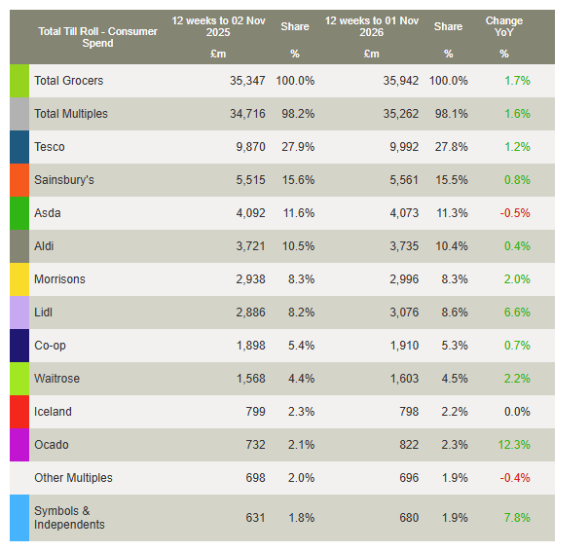
Tesco, Britain’s largest grocer, now commands a 27.8% share, with sales 1.2% higher over the latest 12 weeks.
Sainsbury’s increased by 0.8% to give a share of 15.5% which is the highest share the grocer has seen since April.
New Asda CEO David Potts starts his role with a market share of 11.3%, as more than half of households shopped in Asda stores or online over the last three months.
Britain’s fourth largest grocer, Aldi, saw sales go up by 0.4%; this brings the grocers market share up to 10.4%.
Co-op’s sales were 0.7% higher than a year ago, meaning the convenience specialist now accounts for 5.3% of the market, while Iceland takes a 2.2% share.