

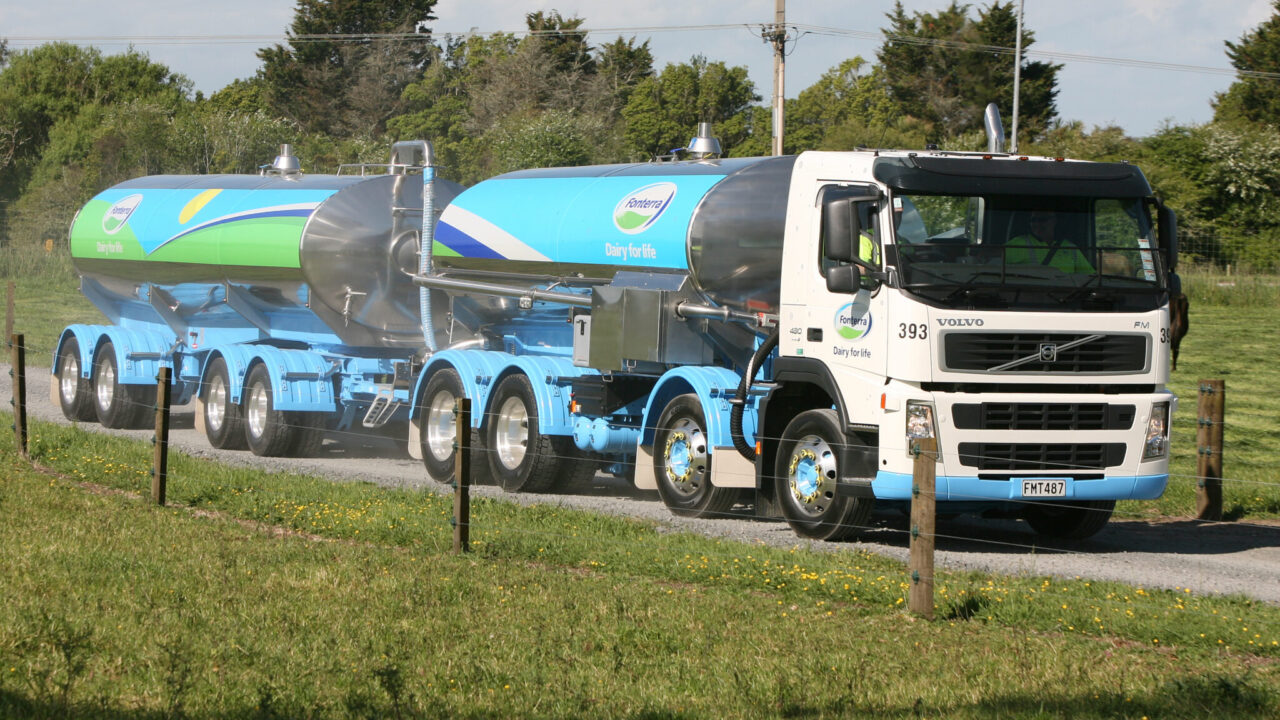
Fonterra has released half year interim results, showing “continued momentum” in its performance.
It has reported revenue of NZ$13.9 billion in the first half of the financial year, up by $1.3 billion.
The New Zealand dairy co-op has announced an interim dividend of 24c per share, fully imputed from continuing operations.
It also confirmed a special mainland dividend of 16c per share, fully imputed, representing 100% of the Mainland Group’s FY26 earnings while under Fonterra ownership.
The co-op has also lifted its forecast farmgate milk price mid-point for the season from $9.50 per kilogramme of milk solids (kgMS) to $9.70, with the range changing from $9.20-$9.80/kgMS to $9.40-$10.00/kgMS.
Fonterra said that “given the strength of these interim results, and our contracted commitments for the second half of the year, we have also adjusted our full year earnings guidance for continuing operations from 45-65c per share to 50-65c per share”.
Performance
Fonterra CEO Miles Hurrell said these changes to the forecast farmgate milk price and earnings ”reflect improvement in global commodity prices and the co-op’s strong underlying margins and cost control”.
However, Hurrell noted that “significant volatility remains, particularly as the conflict in the Middle East continues”.
“The underlying performance of Fonterra’s continuing business is stable, allowing the co-op to return all earnings associated with the Mainland Group business and lift our forecasts for the remainder of the year ahead,” Hurrell said.
“Demand for our products is strong, and we’re focused on our plan to maximise both the farmgate milk price and earnings.”
The record date for the two dividend payments will be March 30, and the payment date will be April 14.
This is also the date Fonterra is targeting for payment of the $2.00 per share capital return from the Mainland Group divestment, based on the transaction completing at the end of March.
Business performance
Total group reported operating profit increased to $1,231 million in these half year results from $1,107 million the year prior.
Reported profit after tax is $750 million, equivalent to earnings per share of 45c and up on 44c last year.
When excluding the costs associated with the consumer divestment, Fonterra’s normalised earnings per share is 51c.
The co-op delivered a return on capital of 11.2%, up on this time last year and in line with the target range of 10-12%.
“The first half of the year has been shaped by strong milk flows, with the co-op collecting record milk volumes in the South Island so far this season,” Hurrell said.
“When combined with several adverse weather events, these conditions have put pressure on the operations of all New Zealand milk processors.
“We have been able to navigate through these challenges due to the resilience of our network.”
Fonterra’s market performance has been strong, with the ingredients business delivering a return on capital of 11% and foodservice a return on capital of 12.6%.
Fonterra’s Mainland Group performance improved during the first half of this year, primarily due to a favourable commodity price cycle.
Divestment
Over the course of FY26, Fonterra said it has “made significant progress” on the divestment of its global consumer and associated businesses, Mainland Group, to Lactalis for $4.22 billion.
The transaction is unconditional and expected to complete at the end of March 2026.
“Our focus now is firmly on our strategy to grow value for farmers as a global B2B dairy nutrition provider, working closely with customers through our high-performing Ingredients and Foodservice channels,” Hurrell continued.
“The foundation of our co-op is our New Zealand milk supply.
“Fonterra has made it easier for new farmer suppliers to join the co-op and share up over time through changes to our shareholding requirements, with greater flexibility in the level of investment required.
“We are focused on maximising value from farmers’ milk and are building new manufacturing capacity across several New Zealand sites to help meet growing demand for our high-value proteins, butters and creams.”
Outlook
Looking ahead, Fonterra said the conflict in the Middle East is having an impact on its supply chain and ”has the potential to increase Fonterra’s inventory levels and costs over the course of the second half of the year.
There’s also the potential for further volatility in global commodity prices.
“The conflict is a complex and dynamic situation that is changing daily, but we are confident that we’re on the right track to get product to customers,” Hurrell said.
“Our business is designed to manage volatility,” he added.
