Proposed EU budget sees 30% rise, CAP protection ensured

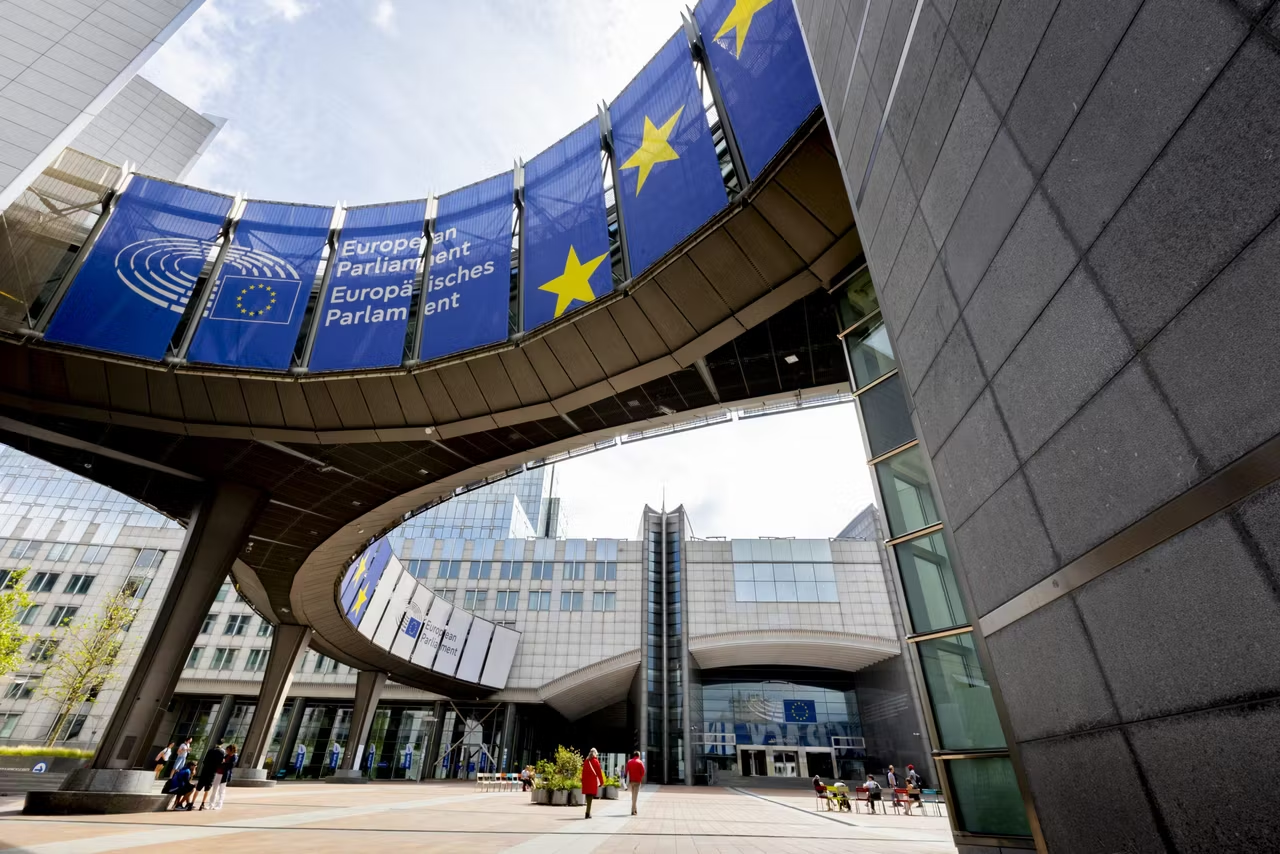
An "ambitious" €1.62 trillion budget for the 2028-2034 Multiannual Financial Framework (MFF) has today (October 10) been proposed in a revised negotiating box for the next long-term EU budget.
Presenting the proposal during a press conference in Brussels, Irish Minister for European Affairs Thomas Byrne speaking on behalf of the Irish Presidency of the Council of the EU, said this budget amounted to 1.16% in EU GNI (or 1.05%, excluding repayment of Next Generation EU common debt).
This also represented a 30% increase on the current MFF, he said.
"Given the need for a more balanced position on volume, the Irish Presidency has also outlined overall savings of 8% (€141 billion) on the European Commission’s proposal.
"Savings have been found across all headings, while also maintaining key priorities, thus ensuring that nearly all programmes see significant increases when compared with the current MFF," according to Minister Byrne.
Irish CAP allocation
Sources close the negotiations said, that while some may question why the Irish Presidency had not done more to provide for farmers and increase the Common Agricultural Policy (CAP) allocation, the Irish position on CAP was made clear to the public, member states and EU institutions before the Irish Presidency began in July 2026.
"We advocated strongly on CAP, in advance and during negotiations, under the Danish and Cyprus Presidency.
"Many of the positive changes to sectoral regulations and the negotiating box were made in part due to the strong advocacy of Ireland and likeminded member states.
According to the sources, the Irish Presidency has protected CAP and "this must be viewed in the context of demands for significant reductions across the entire MFF".
They stated that the Irish Presidency had retained the volume for CAP as set by the Cyprus Presidency.
'Honest broker'
"The Irish Presidency's role in negotiations for the MFF was clear: we must act as an 'honest broker' on behalf of the council in delivering workable compromises on the MFF.
They said that by retaining the volume as proposed by the Cyprus Presidency, the negotiators were confident "that the compromise we have presented is one that not only address the priorities of the majority of member states, but also the Irish farming and agricultural communities".
These included the rural target, adding the option of flexibility frontloading for the CAP, as well as addressing some key governance and implementation concerns.
The publication of the proposal follows three months of "in-depth engagements on the 2028-2034 MFF", he said.
Minister Byrne explained that the objective of the revision was to "present an ambitious, modern and flexible budget that invests in new and emerging priorities and protects treaty-based policies.
These included CAP and Cohesion, "while at the same time reflecting the fiscal realities that all member states face".
"At the core of the next MFF is a bold focus on competitiveness, research, innovation, security and defence, with a level of ambition for these priorities that is unprecedented in any long-term budget," Minister Byrne said.
He added that it responded to the calls "from a majority of member states to protect Cohesion and CAP as essential, treaty-based EU policies".
"These are valued, impactful, and proven policies that support our regions, our rural communities, and our farmers."
According to Minister Byrne, the revision sought to bridge the differences between member states on "long-term spending priorities, providing the basis for the next stage of discussions".
He said it formed the basis of a compromise on fundamental questions of volume, "where the EU should prioritise its funds and how it will generate its revenue".
Minister Byrne stressed that the publication of the proposal was a pivotal step in advancing negotiations to allow for a timely agreement for the benefit of citizens, communities and beneficiaries.
"This is not the end point, we can see a clear pathway now because of the front-loading flexibiity and rural target changes where we can close that gap over the coming months.
"When it's finalised, I am confident that the next EU budget will be a testament to our ability to look beyond domestic positions - to work collectively to advance our shared objectives," Minister Byrne said.