

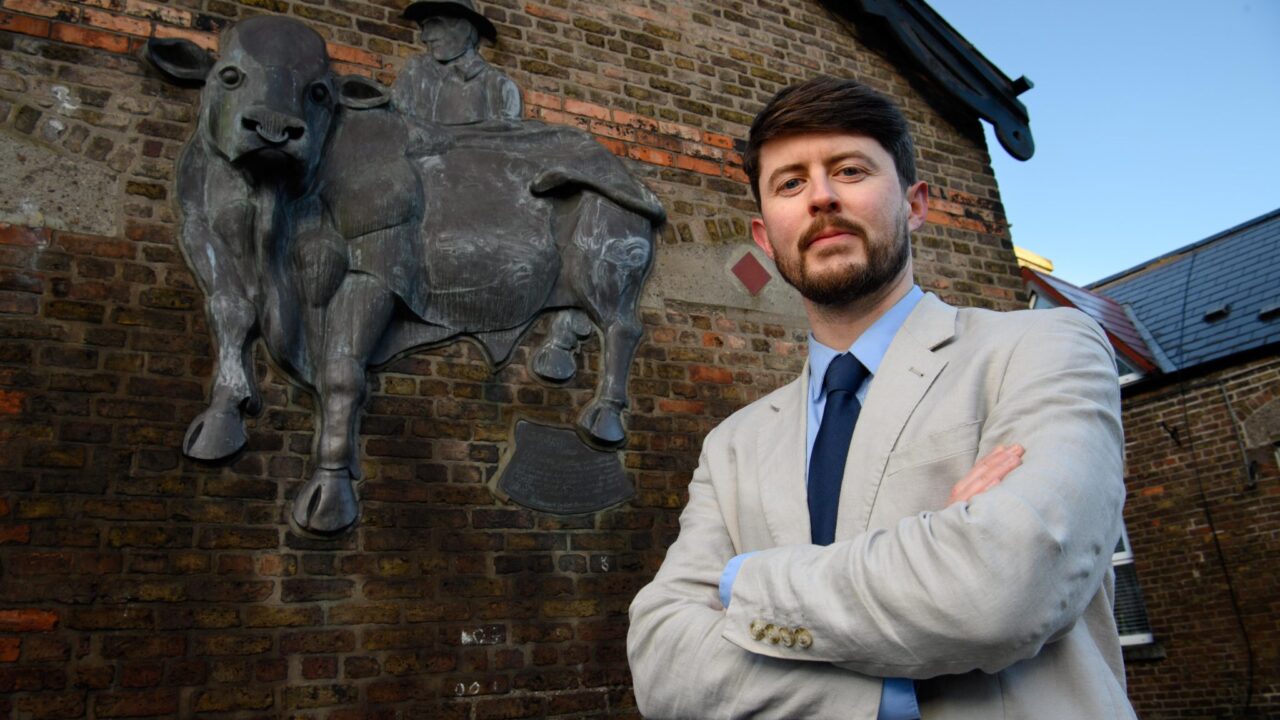
A University College Cork (UCC) researcher’s project has received €2 million in EU funding to investigate how commercial cattle farming first emerged in Europe.
The emergence of cattle farming set in motion economic, social and environmental shifts that shaped the continent from the medieval period to the modern era.
Led by UCC researcher Dr. Eugene Costello, the project aims to uncover the pre-industrial roots of commercial cattle farming, an industry that reshaped Europe’s landscapes and evolved into a major force in the global food economy.
Five-year project
The five-year project will examine how beef and dairy production intensified from around 1240 up to 1840.
Researchers will trace how market-focused cattle farming emerged, how it fuelled the growth of towns and trade networks, and how rising demand reshaped the daily lives and landscapes of rural communities.
Dr. Costello has been awarded a €2 million European Research Council (ERC) Consolidator Grant to lead the project, ‘DeepCattle: The Deep History of Commercial Cattle Farming in Europe’.
Dr. Costello is an archaeologist and historian in UCC’s School of History and Radical Humanities Laboratory.
She said: “This ERC award gives us the chance to show how a major global industry took shape long before the modern era.
“By combining evidence from history, archaeology and environmental science, we will be able to uncover the roots of commercial cattle farming and reveal how it has shaped the environment and economy of Europe.”
Detailed case studies
Researchers will use a landscape-based approach, with detailed case studies in Ireland, Scotland, and Sweden, and added comparisons from the Alps and Hungary.
Looking across these regions will allow the team to explore cattle farming in a range of environmental and social contexts and include both beef and dairy systems.
One strand of work will use archival manuscripts, historic maps, remote sensing and archaeological fieldwork to identify changes in cattle- and land-management practices.
Another will assess how expanding cattle grazing affected rural habitats and biodiversity, using pollen analysis and sedimentary DNA.
A third strand will analyse historic routeways and trade data to trace how increasing amounts of cattle, butter and cheese were moved from rural areas to emerging urban centres, quite literally feeding their growth.
Dr. Costello said: “This project will upend how we view Europe’s economic growth, particularly the rise of its great cities.
“It will push the focus outwards, investigating the role of supposedly ‘peripheral’ rural communities in fuelling urban growth, and the costs for them of doing so.
“We will highlight the fallout of rising urban demands for meat and dairy, demonstrating how the intensification of cattle farming transformed rural society and biodiversity.”
‘Groundbreaking’ – UCC vice president
Prof. John F. Cryan, UCC vice president for research and innovation, said: “Congratulations to Eugene on securing such a highly competitive and prestigious ERC Consolidator Award.
“His DeepCattle project is groundbreaking in its potential to investigate the historical and archaeological features of the commercial cattle industry, as well as the very important business development and sustainability aspects of this sector.
“I also welcome the opportunities that this award will offer Eugene to expand his research team and further develop the international impact of his work.”
