

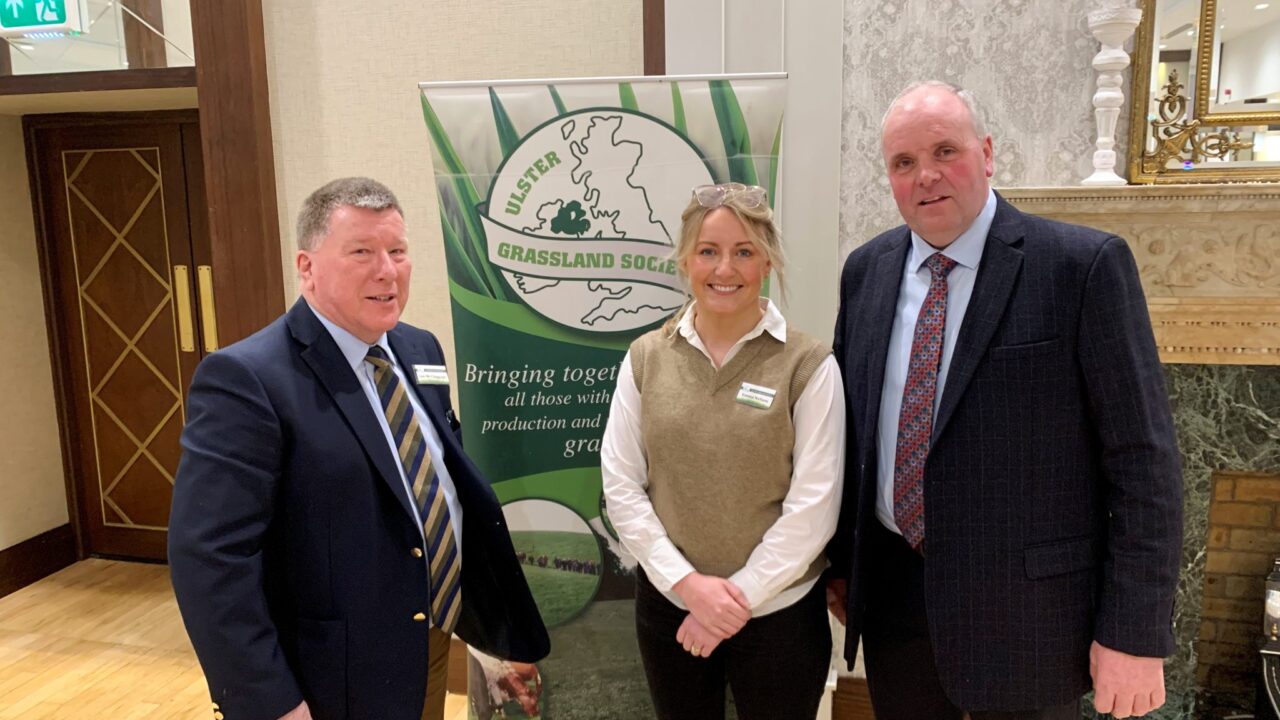
Incoming Ulster Grassland Society (UGS) president, Ivor Lowry, has highlighted the significant challenges that bovine tuberculosis (bTB) continues to pose for agriculture in Northern Ireland.
He is calling for the introduction of a new and more effective disease identification test while also highlighting the need for greater numbers of licensed beef finishers who can take in cattle from farms locked up with bTB.
Lowry made these points while addressing the recent 2026 UGS annual meeting and conference.
The farm manager at Blakiston Houston Estates has long-standing experience of the impact that bTB can have on a farm business.
He explained: “The dairy herd on the estate has been locked up with bTB for some time, so much so that we have developed our own dairy-beef finishing project.”

But, as Lowry went on to point out, there is a silver lining to most clouds.
Courtesy of the new beef initiative, multi-species grazing swards have been established with a high degree of success.
Finished cattle are now coming through at 667 days-of-age with an average carcass weight of 335kg.
“The use of Aberdeen Angus and Hereford sires ensures that the finished cattle are also eligible for the respective breed quality schemes,” Lowry continued.
The Aghadowey native joined the team at Blakiston Houston Estates in 1989. This followed a three-year period of employment at Greenmount College, where he had previously been student for four years.
The incoming UGS president further explained: “When I came to the estate, the herd was averaging 5,349L. Today that figure has risen to 8,307L.
“However, our commitment to secure as much milk from grass and forage remains as strong as ever.
“Back in 1989, fertiliser cost £87/t and compound feed could be purchased for £144/t. Today these respective figures have risen to £355 and £280.”
Sustainable Utilisation of Livestock Slurry
Since autumn 2024, Blakiston Houston Estate has been involved in Northern Ireland’s Sustainable Utilisation of Livestock Slurry (SULS) programme.
This entails the use of a mobile slurry separator, which currently visits up to 70 neighbouring farms in the north Co. Down area.
The slurry solids produced are then brought back to the estate where they are used as feedstock for a biogas plant.
Removing solids frees up significant tank space on farms. When used in a biogas operation, the slurry can go towards producing alternative green energy sources.
The SULS programme has also been designed to create local nutrient sources for farm businesses, reducing their reliance on imported chemical fertilisers.