

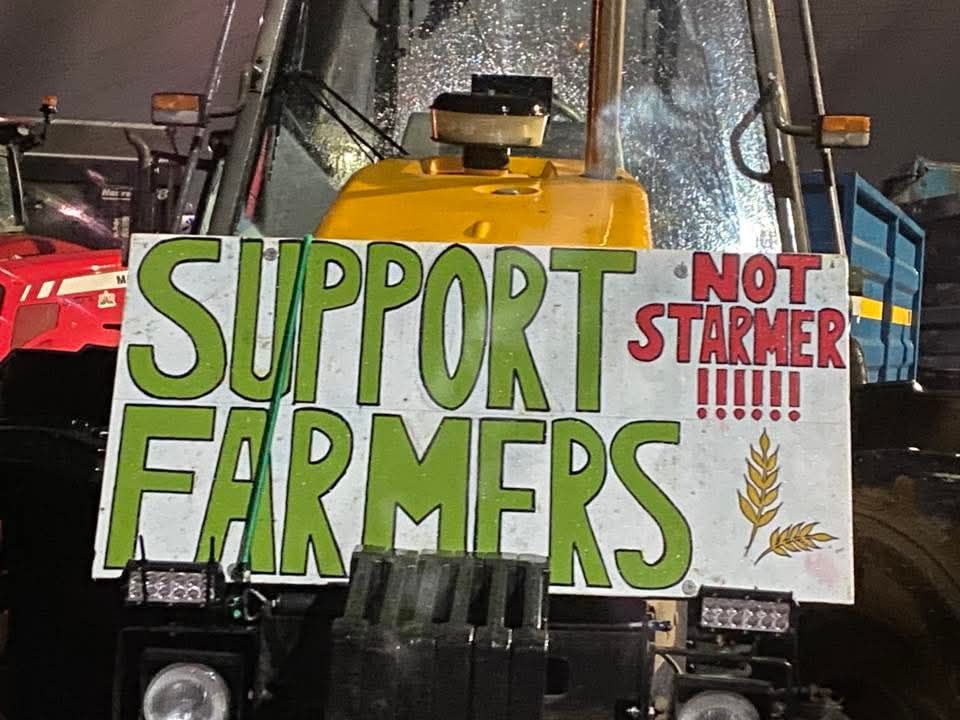
Several protests have been staged by farmers at Lidl distribution centres across England today (Thursday, January 22) to highlight the challenges facing the British agriculture sector.
Farmers formed blockades at depot sites in Luton, Doncaster and Peterborough, with around a dozen tractors at each site preventing lorries from entering and leaving.
Speaking to Agriland from the Peterborough protest, Lincolnshire farmer Ed Pritchard said today’s demonstration was driven by “the current state of agriculture across the United Kingdom.”
“Obviously you’ve still got the inheritance tax going on in the background, but the call we are making today is that we are struggling to make a living.
“We cannot carry on with the poor incomes that we’re making because none of us are going to be able to sustain it for much longer,” he said.
Pritchard, who is an arable and sheep farmer, explained that today’s protests were not aimed at Lidl specifically, but at the wider supermarket sector in general.
Support for British produce
The farmer said the protest’s key message to retailers was the need for stronger support for British produce and increased farmgate prices.
He outlined: “We want supermarkets to appreciate the pressure we are under and we want them to appreciate that we need higher prices.
“We want them to help us achieve that and we want them to back us in the face of the government.”
Pritchard noted that cheap imported produce was a major issue for farmers attending the protest, who are urging Keir Starmer and the current Labour government to introduce tariffs on imported goods.
“We want the government to help us by imposing tariffs on imported produce, to make our British produce more of a saleable item,” he added.
This sentiment was echoed by farmers in attendance at the protest in Luton as well, which is the Lidl’s largest distribution centre in Europe.
Phil, a fifth-generation arable farmer from Northamptonshire, voiced his concerns about how recent trade deals made by the UK government have “opened the floodgates” to cheaper imports, which are produced under lower welfare and environmental standards than British produce.
He argued that supermarkets are benefitting by buying low-cost produce while British farmers face rising input and regulatory costs to satisfy Farm Assurance requirements.
“Simply buy what’s available from UK farmers first, and top up on imports from elsewhere if required, as long as it enters the country to the same standards, and with tariffs on it, to bring it inline with our cost of production,” Phil added.