

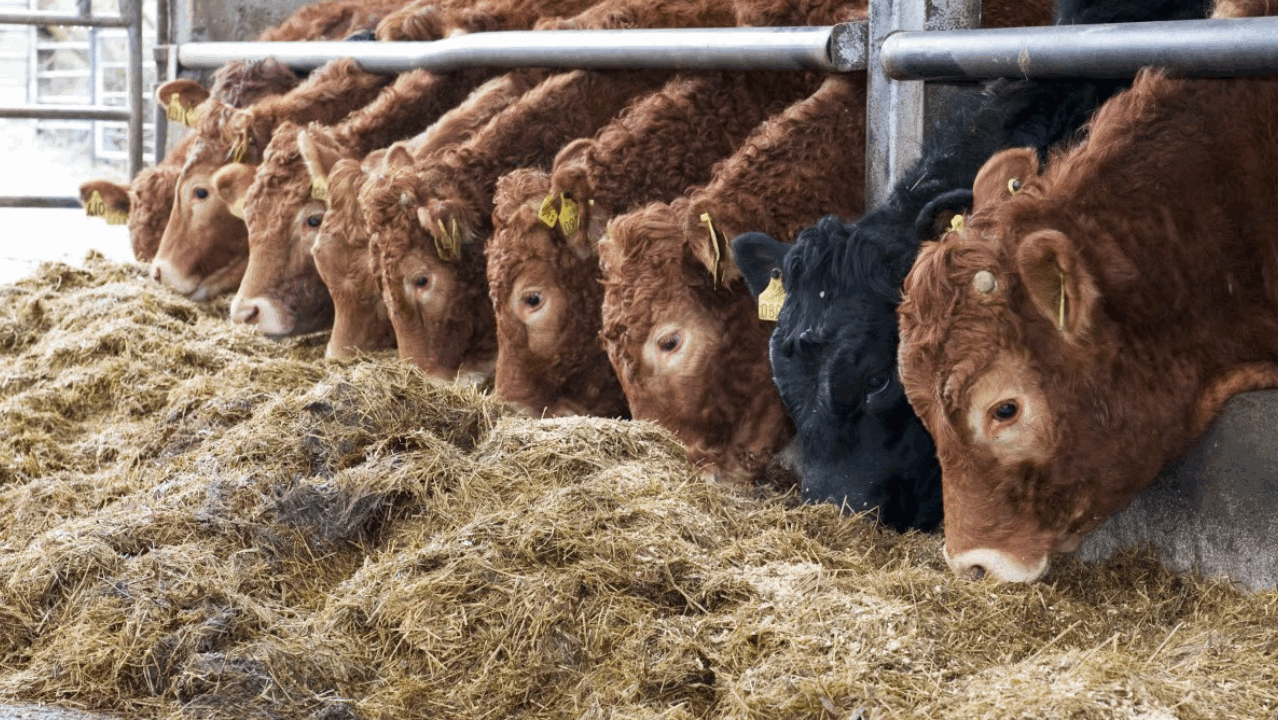
Most well-run suckler herds producing replacement heifers will focus closely on the key management areas of these replacement heifers from birth to breeding.
Improving overall suckler herd efficiency requires careful management of replacement heifers, as the performance of young females entering the breeding herd has a major influence on long-term herd productivity.
College of Agriculture, Food and Rural Enterprise (CAFRE) beef and sheep adviser, Jack Friar previously highlighted key tips on post-calving cow management in maintaining herd fertility.
As well as this, he also offered suckler farmers some advice for managing their future breeding cows within the herd.
“Ensuring these animals reach breeding weight at the correct age will influence their lifetime performance within the suckler system,” he said.
Suckler farms in Northern Ireland are encouraged to achieve an average age at first calving of 32 months or less.
However, from a production and herd productivity perspective, calving heifers at closer to 24 months-of-age represents the most efficient system – where management and growth targets allow, Friar explained.
Naturally enough, earlier calving reduces the period during which heifers remain as non-productive and allows heifers to enter the breeding herd sooner, increasing the number of calves they can produce over their lifetime.
But achieving these targets requires careful management of heifer growth from an early age.
“As a guideline, heifers should reach 60-65% of their mature body weight at first service.
“If heifers fail to reach this level, their fertility performance may be reduced and the age at first calving can quickly slip beyond target,” Friar said.
Managing breeding age is not a quick fix
The CAFRE adviser explained that where there is scope to reduce the age at first calving, achieving it is not a quick fix.
“Monitoring liveweight gain throughout the grazing season can help ensure animals remain on track,” ne said.
“Regular weighing, or at least regular handling and assessment, allows farmers to identify heifers that are not performing and act early.”
Friar said that grass should form the basis of the heifer diet during the grazing season and the best way to offer grass to heifers is via a rotational grazing system.
“Rotational grazing systems can improve pasture utilisation and further maintain leafy, high-quality grazing to maximise intake and support strong liveweight gains,” he continued.
Ensuring heifers have consistent access to high-quality grazing throughout the season will help to avoid any ‘check periods’ in growth.
“Achieving these growth rates ensures heifers reach breeding weight at the appropriate age,” Friar said.
During the second grazing season, heifers should continue to grow steadily so they approach breeding weight in good time.
“In many systems, heifers should weigh around 380-420kg at breeding, depending on breed type, mature cow size, and the age at which they are to be served.
“The important point is that breeding targets should be linked to mature cow size rather than applied as a single fixed figure across all herds.”
Pre-breeding nutrition
Nutrition during the period before breeding is particularly important.
Heifers should be on a rising plane of nutrition before service to maximise conception rates and where grass supply becomes limited, supplementary feeding may be required to maintain growth and ensure heifers continue to move towards breeding targets.
“Heifers that experience a check in performance before service are more likely to cycle late, show weaker heats or conceive later in the breeding period.”
Pelvic development
Friar explained that pelvic development also plays an important role in heifer performance and in the risk of calving difficulty.
“Heifers that are underdeveloped or too small at breeding may experience a greater risk of dystocia at first calving so adequate skeletal growth before breeding is therefore essential.
“Where heifers fail to reach recommended breeding weight, they may not have sufficient pelvic size or maturity to calve unassisted.
“Ensuring heifers reach adequate weight and frame development before service can therefore help reduce calving difficulty, improve calf survival and increase the chance of heifers remaining in the herd long term.
Bull selection
The bull choice is also an important decision when mating the replacement heifer.
Using bulls with favourable calving ease Estimated Breeding Values (EBVs) can help reduce calf birth weight and the likelihood of difficult calvings.
“Difficult calvings not only increase labour and calf loss risk but can also negatively impact the heifer’s fertility in the following season.”
Breeding the heifers first
The CAFRE adviser noted that in many suckler systems, heifers are bred slightly ahead of the main cow herd.
“This management practice allows heifers extra time to recover after calving before they are required to conceive again during their second breeding season.
“Where heifers calve late in the season they may struggle to recover sufficiently before breeding begins again, increasing the risk of extended calving intervals and eventual culling from the herd.”