

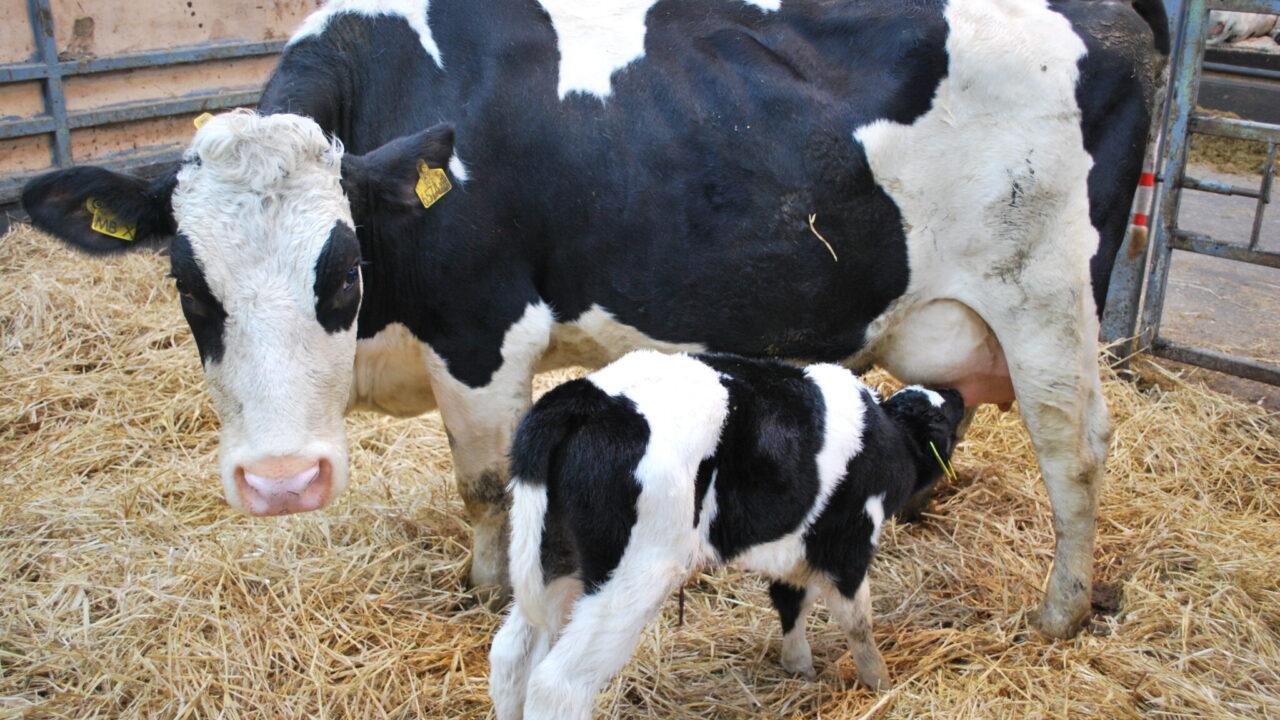
As the calving season rapidly approaches, preparations must begin to ensure calves get the quality colostrum that they need.
Antibody transfer does not occur in utero, leaving the calves vulnerable at birth and reliant on colostrum to build their immune system.
Calves who do not receive adequate quality colostrum are at a significantly higher risk of reduced performance, illness, and even death.
To ensure you have adequate volumes of beestings ahead of calving, measures such as ensuring cows are on track to calve down at the correct body condition score (BCS) of about 3.25 should be in place.
In fact, the cow’s whole diet ahead of calving is essential in producing quality beestings.
This includes feeding high quality dry cow minerals to dry cows right up to calving, and bridging the gap with supplementations if silage has a level of dry matter digestibility (DMD).
Quality colostrum
Good quality beestings are like a vaccination for calves, as they provide the calves with immunity, giving the calf the protection it needs, along with feeding transition milk for five days.
Colostrum quality can be measured using a colostrometer or a brix refractometer, with values above 22% being suitable to feed new-born calves.
However, farmers need to remember the ‘1-2-3’ colostrum rule as follows:
- The calf gets colostrum from the first milking for the first feed;
- Give it within two hours of the calf’s birth;
- Give at least 3L of milk to the calf.
The timing of colostrum is crucial as it influences the antibody levels in colostrum.
These antibody levels are highest when collected post-calving within eight hours, and deteriorate drastically as they are diluted within the udder as more milk is produced.
Maintaining a high standard of hygiene while harvesting the beestings is also essential so as to not pass on any infection to the calf before the antibodies kick in.
If the beestings do have a high total bacteria count (TBC), there may be an impact on passive transfer of immunity to calves.
This is also the case if the colostrum is not either fed immediately or stored at 4℃ for a maximum of 48 hours.
Research has shown that when high TBC colostrum was not stored in a fridge, bacterial growth increased and consequently, the absorption of antibodies was reduced.