

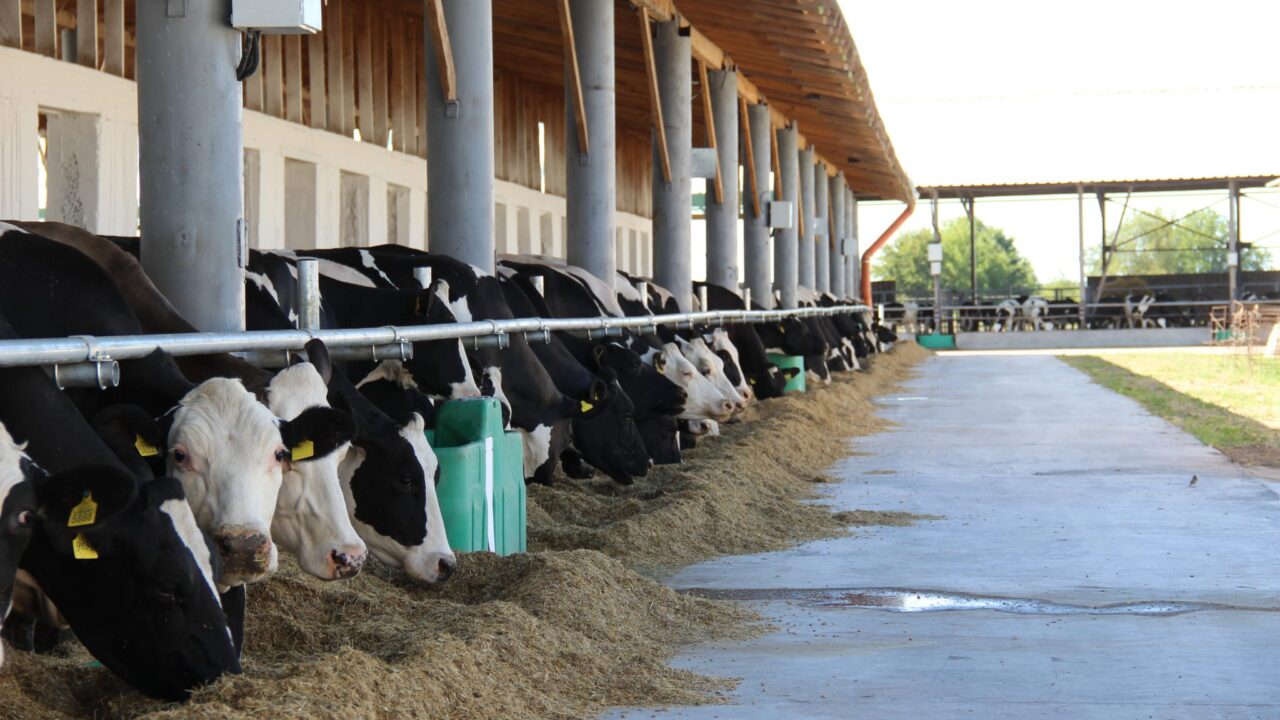
Milking cows near the front line of the war in Ukraine is a huge daily challenge but one the staff at Ponory LLC Farm carry out with the hope the conflict will end soon.
It’s business as usual at the farm located in the Chernihiv region of northern Ukraine, but plans are in place to build a new 1,000-cow unit once the fighting stops.
Built back in Soviet times, Ponory LLC Farm has a deep history but lacked good management and decent production. However, that changed in 2012 under new ownership.
Volodymyr Sysa, director of Ponory LLC Farm, said: “Back in 2012, the farm had 273 cows with productivity of just 12.2kg per cow per day, only about 4,465kg per cow per year.

“Today, we operate two farms in two different villages; the older one with tie-stall housing and a newer one with loose housing.
“We acquired the abandoned farm in a neighbouring village on the eve of the Russian full-scale invasion, and we started restoring that site for loose housing in 2023.”
Farming in Ukraine
The first farm houses 848 cattle in total, including 400 milking cows on the tie-stall system, while the second farm has 205 cattle.
All cows are milked three times a day, averaging 13,066kg/cow/year at 3.2% protein and 3.6% fat, supplying 22t of milk for processing each day.
According to the Milk Records of Ukraine 2024 rating conducted by the Association of Milk Producers (AMP), the farm ranked sixth in the top 20 most productive dairy farms in the country, having yielded an average 11,661kg of milk per cow in 2023.

Sysa said: “We do not buy in heifers, instead we ‘Holsteinised’ the herd and built it up using our own replacement heifers.
“Our technologist on the farm is in charge of selection, deciding which cows to breed from, and then a genetics company supplies the semen. Every cow is ‘AI-ed’, some with sexed semen.
“Our cows are housed and fed indoors on a total mixed ration. At the tie-stall site, cows are kept in two cowsheds, each holding 196 head. Nothing has fundamentally changed here since Soviet times.
“We have installed a milk line, equipped feeding tables, reconstructed the stalls, and added positive-pressure tube ventilation in the buildings,” he added.
The farmer explained that loose housing proved to be the most optimal option for the new site and they even found a used 2X8 DeLaval herringbone milking parlour that was in excellent condition and almost four times cheaper compared to a new one.
“That newer farm was completed in 2023, with 96 milking cows housed in maximum comfort. They have a wide feed and manure alley, comfortable stalls, and two drinkers installed for every group of 24 cows,” Sysa explained.

“The ventilation is tunnel-style and operates automatically. Powerful exhaust fans are placed at one end of the building to pull out stale air, and evaporative cooling pads are on the other side, through which fresh, cooled air enters the cowshed.
“We feed the same ration at both sites, but the difference in milk productivity is noticeable.
“The cows in the loose housing produce 1.5-2L more per cow per day resulting in an average daily yield of 43-44L.”
Labour and grain
Having enough workers on the two farms is another challenge for Sysa.
Six staff look after the cows at the loose housing farm, while 14 milkmaids are employed at the tie-stall farm, with an additional six more to look after the youngstock.
Sysa said: “Our exact milk price and cost of production varies month to month and is sensitive to market and war conditions.

“During 2025 our farm gate price fluctuated from €34-€40/kg, which is approximately 35% lower than the average milk price in EU. Our milk is sold to Danone, located 400km from our farm,” he said.
Ponory LLC Farm owns 1,000ha growing corn, winter rye, sunflowers, wheat, soybeans, and also hay, for its own feed rations.
“We grow 700ha of corn, up to 200ha of silage, up to 200ha of wheat, 60ha of soybeans, and 150ha of winter rye for silage,” Sysa explained.
“Our own feeds include corn and rye silage, small grain haylage, hay, corn and wheat grain, corn paste, roasted soybeans.
“Purchased feeds include sunflower meal, soybean and rapeseed cake, bran, raw brewer’s grains, beet pulp, molasses, and feed additives.
“We use our own self-designed feed mill to mix our rations, formulated specific to the different animal groups.”
So far, the farm’s biggest investments have been in cow comfort technologies, including the ventilation system in tie-stall barns, and tunnel ventilation with evaporative cooling pads in the free-stalls.

For its energy production, the farm replaced its 76kW electric boilers with a solid-fuel boiler, saving up to 70kW and paid back the investment in seven months.
Future
Sysa has big plans for the future, once the war with Russia has ended, which means expanding to 1,000 cows.
“We would like to build a new cowshed for 1,000 head. Given our land bank of 1,000ha, it is entirely realistic to maintain a milking herd of that size,” he said.
“The two reconstructed cowsheds could then be used for early and late dry cows, the maternity ward, and fresh cows.
“At the tie-housing facility, one half of the production site, where two cowsheds are located, will remain unchanged, and the second half is being intensively developed for replacement heifers.
“In fact, we are already creating the foundation for a heifer complex.”
Sysa explained that they are taking small steps now and are systematically changing the existing facilities with a view to the ultimate goal of milking a herd of 1,000 cows.
Related Stories

‘Persistent concerns’ over updated Ukraine trade deal – EU farmers

South African livestock industry in crisis as FMD spreads like wildfire

430k sheep and goats culled in Greece due to pox virus
.editor-styles-wrapper .wp-block-acf-related-stories-block {
max-width: 960px !important;
background-color: var(–color-gray-default);
padding-inline: 40px;
padding-top: 8px !important;
padding-bottom: 20px !important;
}
