

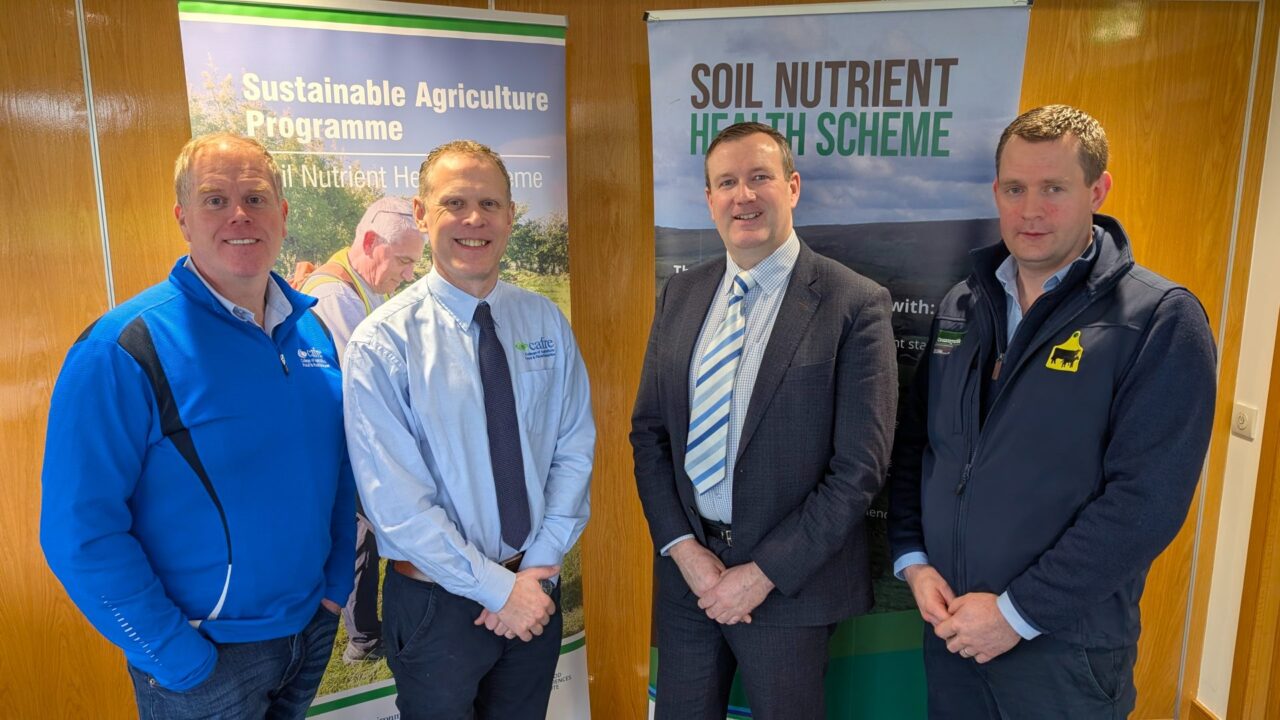
Countryside Services Ltd., has been appointed to deliver key knowledge transfer elements of the Northern Ireland Farming for Sustainability Scheme.
Countryside Services will support the College of Agriculture, Food and Rural Enterprise (CAFRE), delivering face-to-face training and themed peer-to-peer group facilitation to farm businesses across Northern Ireland.
Head of knowledge advisory service, CAFRE, Albert Johnston said: “The appointment of Countryside Services will help ensure farmers have timely, practical and accessible training that supports productivity, environmental outcomes and resilience across the sector.”
The first training to be delivered by Countryside Services will be associated with the Soil Nutrient Health Scheme. It is now necessary to complete this training to receive future Farm Sustainability Payments.
If you have still to complete the training, you can do so through online training at CAFRE’s website. For those who prefer to complete the training in person, new dates and venues across the province and booking information can be found at both the CAFRE and Countryside Services websites.
Dr. Andrew Kerr of Countryside Services Limited added: “We’re delighted to partner with CAFRE in delivering high-quality training and facilitated peer learning to support farm businesses increase both efficiency and care for our environment.”
Sustainability payment awareness
Separately, the Department of Agriculture, Environment and Rural Affairs (DAERA) will host a series of awareness events to inform farmers about the new Farming Sustainability Payment (FSP) scheme.
The FSP scheme, which is part of DAERA’s Sustainable Agriculture Programme (SAP), has now replaced its predecessor, the Farm Sustainability Transition Payment.
Applications for the scheme are set to open from March 2 until June 9, 2026, with late penalties applied for applications received between May 16 and June 9.
DAERA stated that FSP “will provide a vital safety net payment for farm businesses and aims to balance support with encouraging farm businesses to manage risks”.