

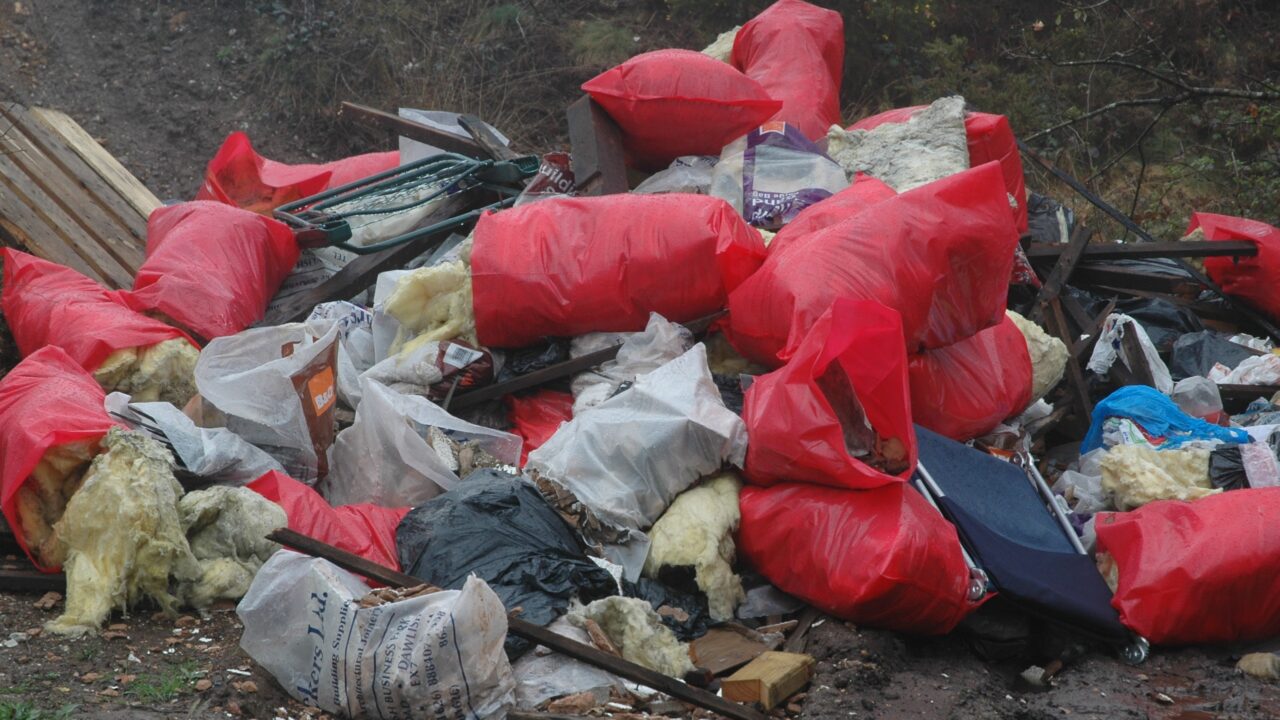
Illegal dumpers are “turning farmland into rubbish tips”, according to the Country and Land Association (CLA).
The farming organisation has called for several measures and supports to tackle fly-tipping, as the latest figures from the Department of Environment, Food and Rural Affairs show that councils dealt with 1.26 million fly-tipping incidents in 2024/2025, marking a 9% increase from the year before.
However, the CLA noted that these figures only account for waste illegally dumped on public land that has been reported to the authorities and do not take consideration any fly-tipping incidents occurring on privately owned land.
A survey carried out by CLA found almost three quarters of farmers who responded are affected by fly-tipping each year, with some targeted multiple times each month.
According to the survey, each incident costs on average £1,000 to clear up, with 85% saying they have invested in measures such as CCTV, lighting, and other security.
Fly-tipping
Gavin Lane, president of the CLA, said that farmers and land managers “have had enough” of fly-tipping, and called on the government to introduce policy to tackle the issue.
The CLA has requested for a national fly-tipping commissioner to be appointed to “coordinate agencies, monitor incidents on private land, and benchmark enforcement performance”.
Another measure that the organisation would like to see introduced is the enforcement of fines for businesses and homeowners whose waste is found dumped.
Additionally, the CLA has suggested more support for victims to be available via a new permit scheme, which would allow farmers to dispose of illegally dumped waste at a disposal site free of charge, given that they did not cause or knowingly permit the fly-tipping.
The CLA president said: “The countryside is increasingly being targeted by organised crime gangs – often violent – who know that rural areas are under-policed and resourced.
“We need to see penalties being enforced that better reflect the severity of the crime, and the seizure of vehicles must be the default penalty to send a clear signal that criminals will face real consequences if they are caught fly-tipping,” Lane added.
CLA
Colin Rayner, who is a CLA member and farms on sites in Berkshire, Buckinghamshire and Surrey, noted that his family have been experiencing fly-tipping on a weekly basis across their farms.
He said: “We wake up to loads of rubbish in the field or farm gateways.
“Our verges are used to dump garden waste and abandon white goods and even dead dogs.
“We just clear up the fly-tipping waste and bear the high disposal costs at the registered landfill site, which significantly impact our farm’s finances,” Rayner added.
Illegal dumping
Another CLA member, George Hurrel, who farms in Cambridgeshire, highlighted washing machines, mattresses, builders’ rubble and large processed waste as some of the items dumped onto his fields and gateways.
He commented: “Not only is it a hazard for people and wildlife, but we also incur significant costs in having to clear the fly-tipping on our land.
“If we don’t remove it, we face being prosecuted; how can it be a fair to have a system that punishes those who are victim of a crime?”
The CLA statement follows several high-profile incidents recently, from the 30,000t of waste dumped in ancient woodland at Hoad’s Wood in Kent, to 20,000t next to the River Cherwell and A34 in Kidlington, Oxfordshire.