

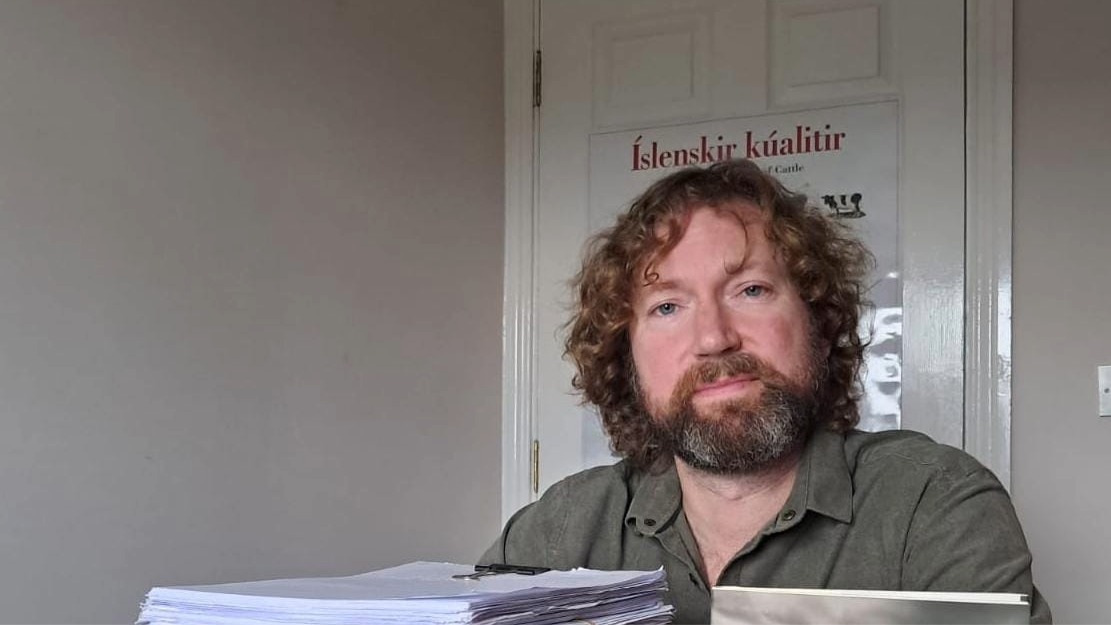
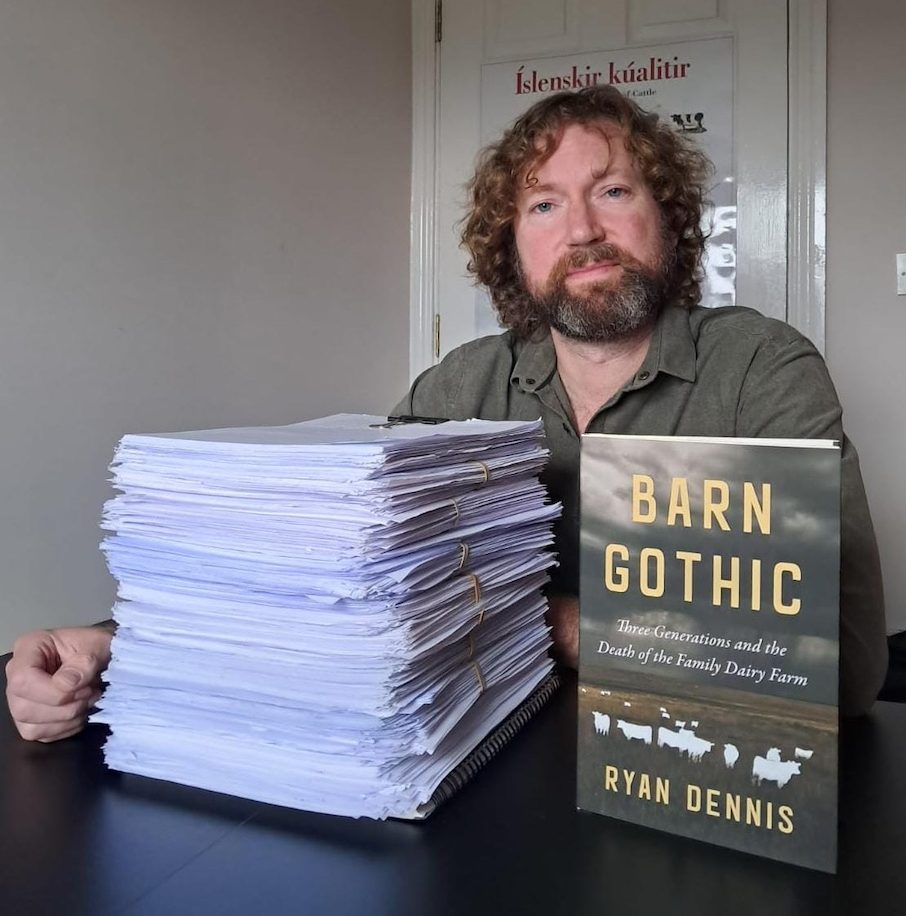
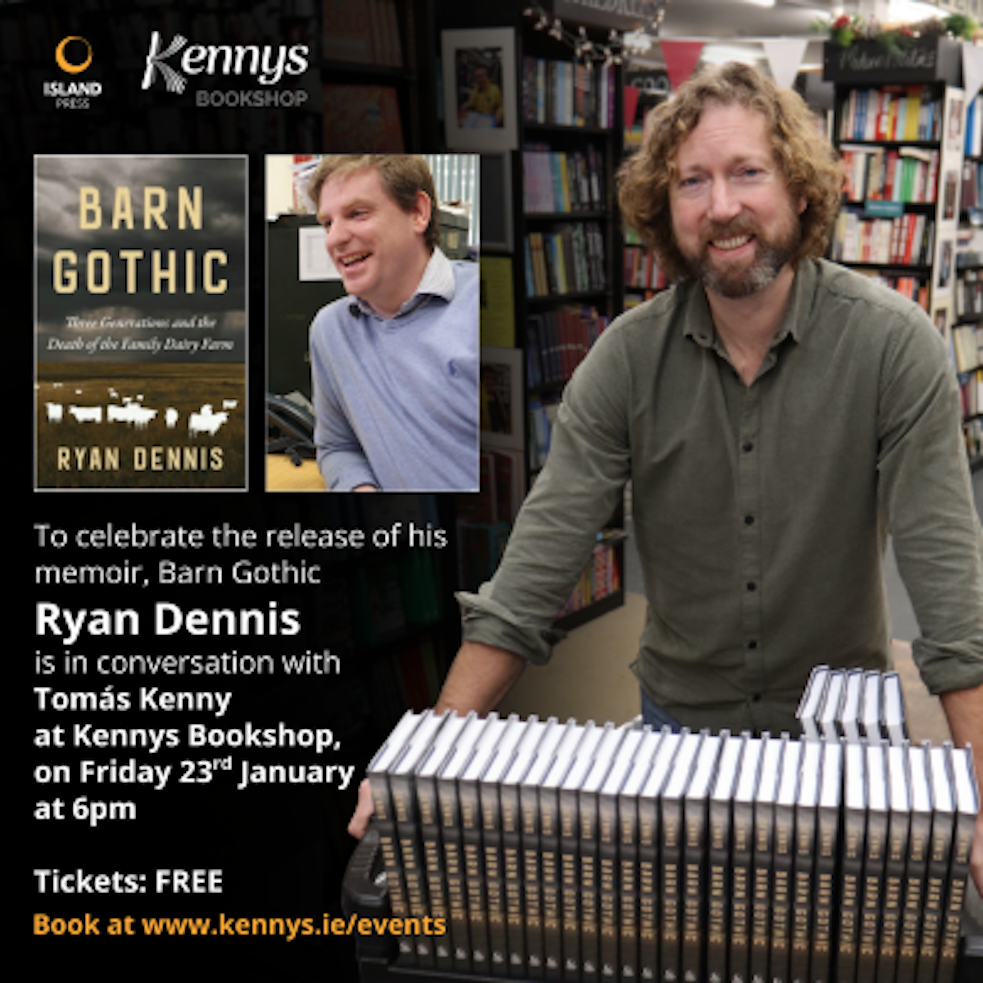
US-born farmer and writer, Ryan Dennis, will have the Irish launch of his recently published memoir titled Barn Gothic: Three Generations and the Death of the Family Dairy Farm in Kenny’s Bookshop, Galway, on Friday, January 23 at 6.00p.m.
Dennis said: “Barn Gothic follows my own family’s story, as well as the larger crisis that has forced half of the US’ dairy farms out of business between 2003 and 2020.
“When my father was injured by heavy machinery on our New York dairy farm, we both accepted it as a risk of agricultural life.
“What was harder to accept was the crushing weight of low milk prices, corporate consolidation, and policies that left family farms like ours struggling to survive.”
Dennis explained how, to try to stay in the dairy industry, they went in 1994 from a 100-cow tiestall barn to a 200-cow freestall barn.
“Although no-one in our family wanted to expand, it seemed necessary for survival,” he said.
“Nonetheless, it became increasingly difficult to keep a farm with only 200 cows profitable under the economic conditions of the US dairy industry.”
The Dennis family faced a series of challenges, including Ryan’s father breaking his back in a skidsteer accident.
“While he was learning to walk again from a hospital bed, he had to fight off banks and lawyers trying to take the farm,” Dennis said.
“The bank, in the end, committed heinous actions that were without precedent, which ultimately put our farm in a hole that it could not get out of.”
Ryan had always assumed that he would take over his grandfather’s farm, if not his parents’ farm.
“However, when it came time to make that decision, it was harder than I had expected.”
Dairy farming economics
The economics of dairy farming had already proved to be unsustainable.
As Dennis milked cows and fed calves, the world outside the barn was changing. Between 2003 and 2020, 40,000 dairy farms went out of business in the US.
“Having already lived in Ireland by that point, it was hard to give up on that ‘other self’ that would have different types of opportunities,” Dennis said.
I think it’s a moment that many children of farmers have to face, and it haunts many of us.
“To be honest, when I returned to Ireland to do a masters in writing, it was largely to run away from the decision of not taking over my grandfather’s farm.
“It was hard to face what that decision meant to both me and my family, whether it was right or wrong, and I needed distance.”
Dennis outlined how he now does the best he can “to make a living from writing-related activities”.
“When possible, I teach creative writing at university. This last semester I taught at UCD,” he explained.
“I also write a syndicated column called ‘The Milk House’ that appears in various countries, as well as run a literary journal by the same name.
With the literary journal, we recently published the 2026 Best in Rural Writing anthology, which we plan to do yearly.”
The author outlined why he feels it is so important that farmers get a fair price for the food they produce.
“I think the largest lesson from what happened to the US dairy industry is that there is a price to cheap food and it’s borne by the producers first and the consumers second,” he explained.
“Because farmers have relatively little countervailing agency in the market, it is important for mechanisms to be in place to guarantee that farmers receive a fair portion on the price of a litre of milk. The market will never do it for us.
“Ultimately, if smaller agriculture is not adequately supported, there will be environmental consequences, rural communities will continue to face decline, Ireland will lose food security, and a lifestyle that defines the nation’s culture will be lost.
“The US dairy industry is a cautionary tale that must be heeded.”
Barn Gothic
Barn Gothic is both a personal elegy for three generations of farmers and a broader reflection on what’s at stake when rural livelihoods disappear.
The memoir also includes advice on what countries such as Ireland can learn from what happened to the US dairy industry.
The response to Barn Gothic has been incredibly moving, according to Dennis.
“Recently, I gave a few readings in western New York State, where I grew up,” he said.
“For nearly everyone in those crowds, it was the first book event they had ever been to, and most, I believe, wouldn’t call themselves big readers.
“However, many said they read the book in a night or two, and the farmers in particular seemed genuinely surprised to see their experiences finally written about.
“So many of them came up to me afterwards and said: ‘That’s what happened to us. That’s our story too.’”
Signed copies of the book are available from Kenny’s and can also be bought at the launch.