

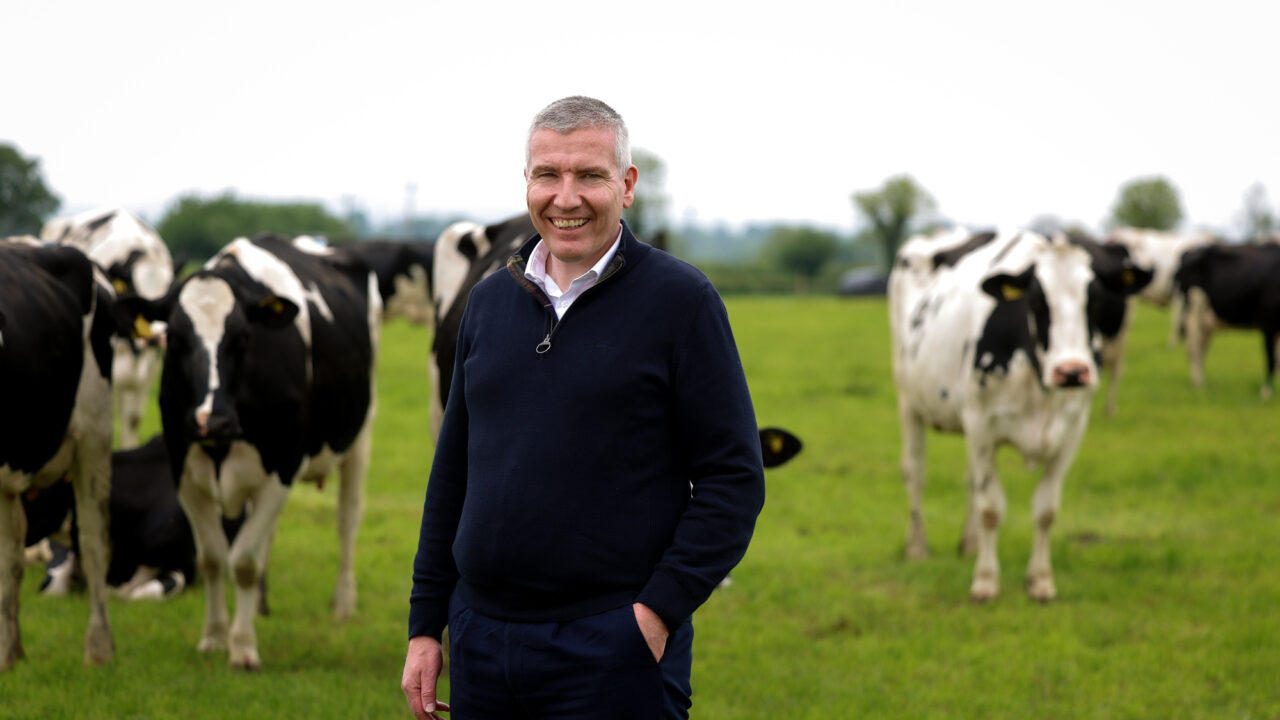
Dairy Council for Northern Ireland (DCNI) chief executive, Ian Stevenson, believes that the year ahead will see a strong focus placed on the issue of food security.
He told Agriland: “By common consent 2025 will have been regarded by many as the year of the environment.
“Various facts and figures are often used to profile the significant role played by Northern Ireland’s farming and food sectors.
“For example, both industries combined produce sufficient high quality protein to meet the needs of some 10 million on an annual basis.”
The DCNI representative emphasised that statistics such as these take on an even more significant profile when set against the backdrop of the current food security levels in the UK.
“This figures come in at just short of 65%,” he continued.
“Or put another way, production agriculture in Northern Ireland currently accounts for 22% of the indigenous food produced in the UK as assessed in terms of the current national production and supply ratio.”
Meanwhile, many countries are now adopting a more protectionist approach, where this matter is concerned. The United States has led the way in this regard.
“Prior to Christmas we saw the Chinese Government issuing a provisional ruling to the effect that it would introduce enhanced tariffs of up to 42.7% on dairy imports from the European Union.
“Overarching all of this is the fact that food security is now widely interwoven within the narrative that is fast evolving, where the issue national security is concerned.
“There are also many uncertainties regarding the status of global trade policies at the present time and dairy has a key role to play in this context, from numerous perspectives.”
Milk in Northern Ireland
The last 12 months have seen milk output in Northern Ireland grow by 9% relative to 2024.
“This reflects the suitability of our climate in terms of grass growth and the availability of high quality water supplies,” Stevenson said.
“And this has been a very positive development in terms of the boost it gives to Northern Ireland’s economy.
“However, of equal importance is the fact that all of this has been achieved in tandem with an equally positive story, from an environmental perspective.
“Significantly the carbon intensity figure associated with each litre of milk produced in Northern Ireland has fallen by 40% since 1990.
“This, in turn, puts a large question mark over the viewpoint that cutting milk output is the way forward when it comes to reducing the carbon footprint of local agriculture as a whole,” he added.
He said that the actual figures available indicate that the resolution of this issue will be complex but that sustainable milk production will be at the very heart of the process.
