

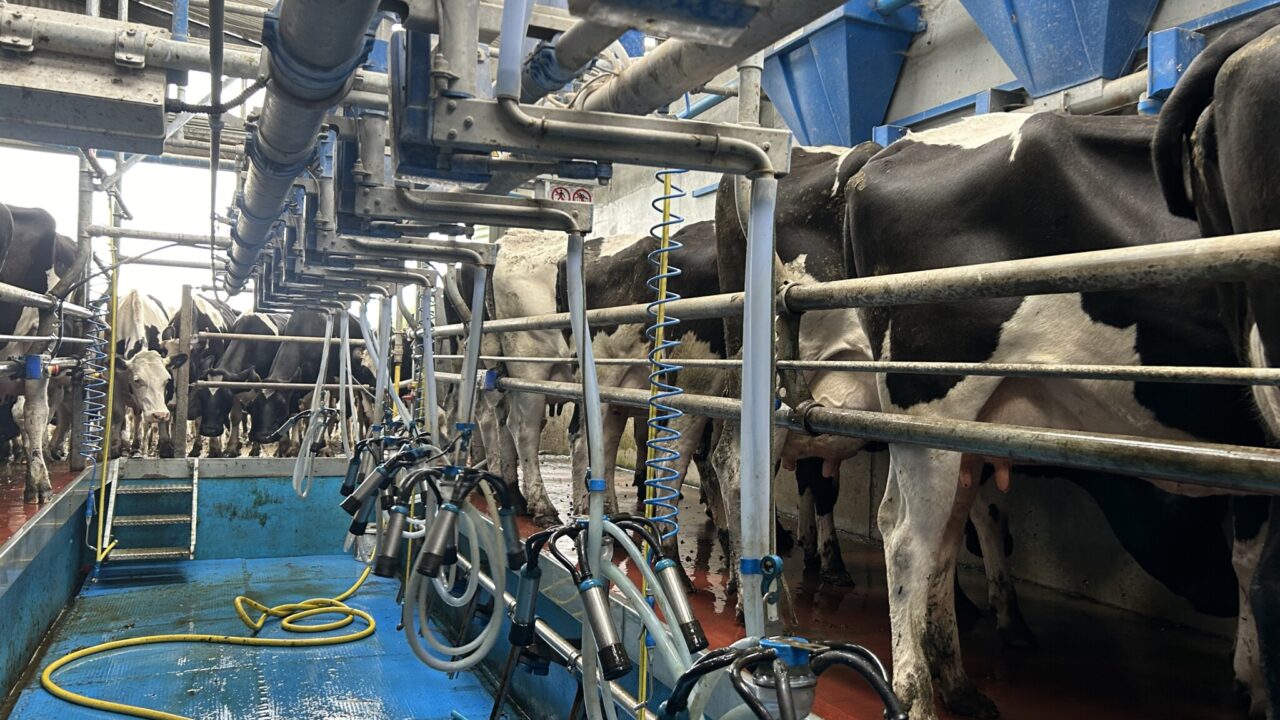
As farmers gear up for the busy calving season ahead, many may be considering once-a-day (OAD) milking in early lactation in a bid to reduce labour intensity.
OAD milking has gained popularity recently, especially for the first couple of weeks when only a small number of cows have calved, but should farmers be implementing it for the whole calving season to relieve pressure?
There can be mixed response to the practice, with some farmers finding it useful to reduce pressure by spending less time in the parlour, as well as reporting improved stock health, while other farmers experience issues with rising somatic cell counts (SCC) when moving to OAD.
Once-a-day milking
Like everything, there is pros and cons to adapting a new system such as OAD milking that you need to weigh up before making any decisions.
As well as the reduced workload, OAD milking can improve herd health in terms of conditioning, lameness, and reduced milk fever, as well as having the possibility of improving reproduction through non-cyclers and heifers.
However, you will most likely have that drop in milk production when you begin, which might not be a viable option as margins will already be considerably tight this spring.
On top of that, the switch to OAD may also lead to an increase in your herd’s SCC, with an additional 20,000-40,000cells/ml in the bulk milk.
Teagasc previously carried out studies at its Moorepark facility to determine the efficiency of OAD milking.
According to the findings, cows on OAD initially experience a 20% reduction in yield, but when cows switched back to twice-a-day (TAD), yields recover quite quickly, with only a 2% difference in yield compared to full-time TAD milkers by week 35 of the lactation.
Is it suitable for your farm?
Some herds may not be suitable for OAD depending on their genetic make up, e.g., high-producing Holstein Friesian cows may not suit that system.
Animals producing high solids but lower volumes of milk, such as Jersey-cross cows, are considered to be more suitable to OAD, as well as cows who are not prone to high SCC.
Farmers who have an SCC of over 200,000cell/ml, OAD milking is not advised. Milk recordings should be analysed from last year to see if the practice is worth trying this spring.
Before making any decisions, farmers need to weigh up the options, ensuring they can withstand the reduced production performance in exchange for reduced labour.
If OAD is not suitable in the early lactation, a 10 in seven milking routine might be a better option just to help reduce the workload.