

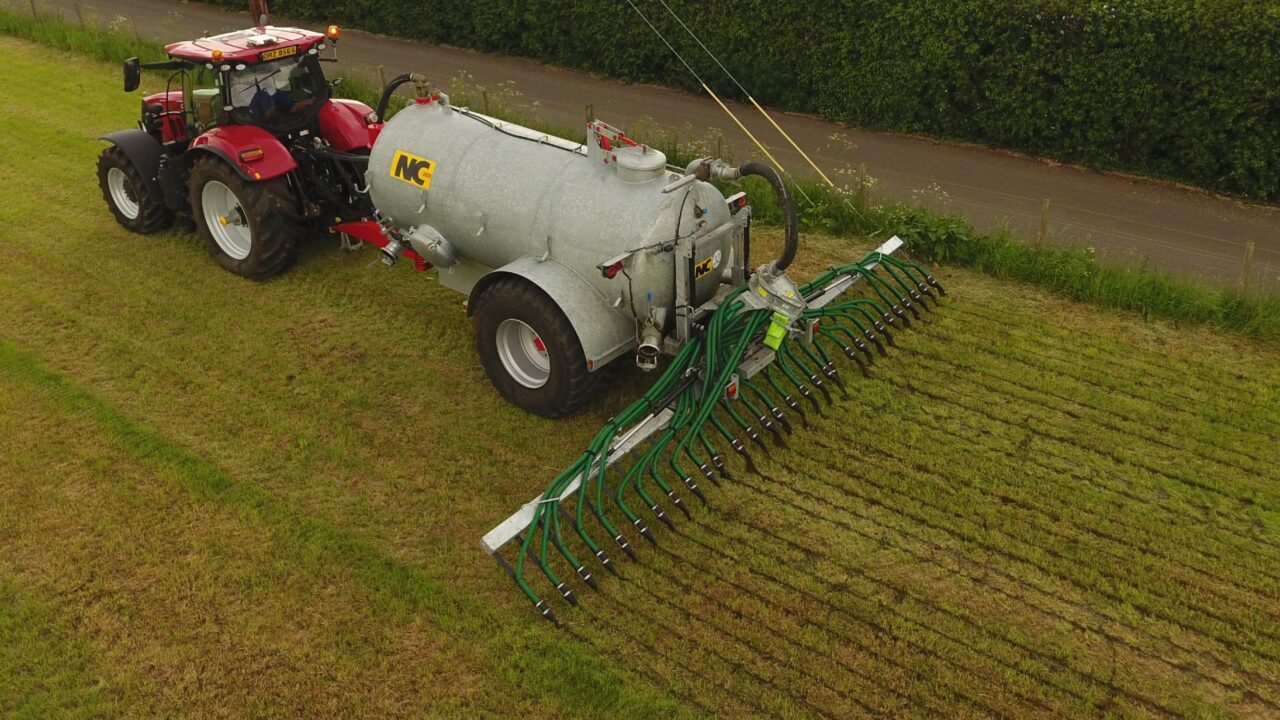
The closed period for spreading slurry is a condition of the Nutrient Action Programme Regulations (NAP) in Northern Ireland and ends at midnight on Saturday, January 31.
Applications of slurry and manure can only resume from this date if ground and weather conditions are suitable to allow the uptake of nutrients from the slurry, e.g., avoid spreading on wet or frozen ground.
Care should also be taken to observe the increased buffer zones and reduced application rates required by NAP during February.
The Department of Agriculture, Environment and Rural Affairs (DAERA) has said that it must also be noted that nutrient applications, whether via organic manure or chemical fertiliser, must only be made where there is a crop need.
Closed slurry spreading period
The closed period for spreading is 16 weeks. The legal requirement for 22 or 26 weeks storage has been designed to allow the flexibility to retain slurry in store until conditions are suitable for spreading.
Climate change is affecting weather patterns and DAERA has said that heavier rainfall incidents can increase run-off from land adding further nutrients to water bodies.
The department said that warmer temperatures are affecting water conditions which further increases the risk of blue-green algae forming blooms during the summer and autumn months.
Increased buffer zones
During the month of February, NAP states that buffer zones should increase from:
- 20m to 30m for lakes;
- 10m to 15m for any other waterway;
- 3m to 5m for any other waterway if using ow Emission Slurry Spreading Equipment (LESSE) in fields with an incline of less than 10% or where the adjoining field is less than 1ha in size or not more than 50m wide.
During February and the first two weeks of October, the maximum single application of slurry must not exceed 30m3 per ha (2,700 gallons per acre). This has been reduced from 50m3/ha (4,500gal/ac).
During February, grass growth is limited by lower soil temperatures and shorter day length, so the nutrient requirement is lower.
A maximum single application of slurry to 30m3, may still exceed the nutrient requirement of the grass plant at this time. This adjustment will help reduce the risk of surplus nutrients being lost into waterways.
Spreading conditions
Outside of the closed period, farmers should only apply slurry when ground and weather conditions are suitable avoiding areas that pose a high risk of nutrient loss to waterways.
Never apply nutrients to waterlogged soils or frozen ground. Avoid applying them to land that is flooded or liable to flood. Refrain from applying if heavy rain is falling or forecast within the next 48 hours.
Applications also cannot be made on steep slopes where there is a risk of water pollution.
Soil temperature
Spreading when soil temperatures are consistently above 6℃ is advised. This means that grass is growing and has the potential to take up nutrients.
Nutrient uptake will be greater when soil temperature rises to 8-10℃ and soil biology really starts to convert nutrients into plant available forms.
The timing of slurry application significantly affects nutrient uptake by plants and the potential for losses to water.
Focusing slurry applications later in the spring when grass growth is higher will increase nutrient use efficiency.
Where to spread
Avoid spreading in paddocks with high connectivity to the drainage network. Wait until later in the spring when the risk of nutrient loss to water is lower.
Spreading on sloping land – care should be taken on all sloping land near a waterway and a risk assessment carried out to determine if you can spread fertiliser (including organic manures) on it.
The following factors must be considered in making these risk assessments:
- Type and amount of fertiliser being applied;
- Time to incorporation of organic manures (land other than grassland only);
- Proximity of waterways;
- Soil conditions;
- Forecast weather condition.
Completing a Nutrient Management Plan
If you have taken advantage of the Soil Nutrient Health Scheme (SNHS) you should use your soil results as the basis for a Nutrient Management Plan.
To complete a Nutrient Management Plan for your farm, the advice is to use the CAFRE Crop Nutrient Calculator available on the DAERA website.
You can enter your crop details and soil analysis results; the calculator will identify the crop requirement.
Choose the appropriate manure type and chemical fertiliser to be applied. The Crop Nutrient Calculator report can then be printed off or saved and used as your fertilisation plan.
Organic manure (slurry) analysis
The nutrient value of organic manures (cattle slurry and manure, pig slurry, poultry litter and increasingly anaerobic digestate) can be highly variable, according to DAERA.
It is beneficial to know the nutrient content of your own farm’s organic manures to allow for accurate nutrient management planning (NMP).
This helps to minimise spend on chemical fertiliser and nutrient leakage to the environment.
Organic manure analysis will provide figures for, percentage dry matter, pH, nitrogen (N), phosphorus (P) and potassium (K). Magnesium, copper, zinc, sulphur and calcium are also included.
Sampling and analysis can be carried out at any time of year but is particularly useful in early spring ahead of the main slurry spreading period. This will allow planning of any chemical fertiliser inputs required to optimise crop growth.
Organic manure sampling kits and sampling instructions are available at DAERA Direct offices.
According to the department, the measures contained within the NAP are designed to improve nutrient efficiency within the farm and improve water quality.
These legal requirements apply to all farms in Northern Ireland. The aim is to improve nutrient utilisation of organic manures and chemical fertilisers while also reducing the likelihood of nutrient run-off into waterways.
Nutrients lost from spreading slurry in the wrong conditions in February and March will be transported to Lough Neagh and other lakes. This occurs at the worst time, as the nutrients promote algal growth in the spring and summer, according to DAERA.