

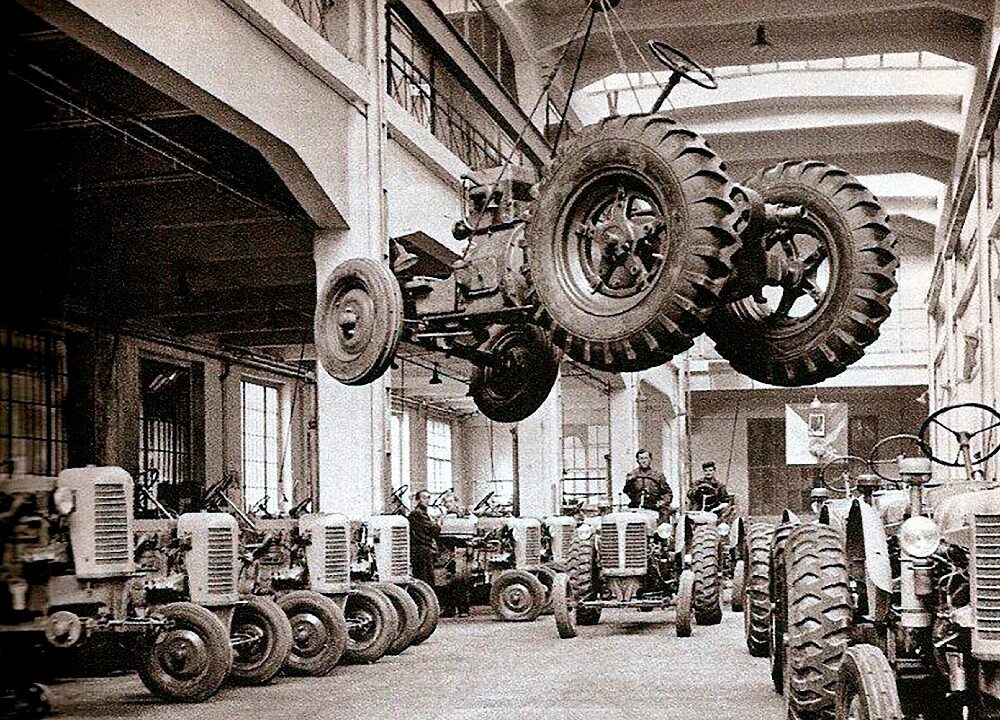
Today, March 15, marks 80 years since the first three Zetor Z 25 tractors rolled off the production line at the Zbrojovka factory in Brno in what is now Czechia.
Over the eight decades, Zetor has undergone technological development, changes in the market and transformations in agriculture itself, all while maintaining its core values; an emphasis on robust construction, simple operation and the practical usability of its machines in everyday work.
The company will celebrate the 80th anniversary of the brand together with the public in April at the AgriShow in Brno, where selected historic ZETOR models will be displayed alongside the new Series 6.
From Z 25 to today
The first Z 25 model was developed shortly after World War II in response for the need of rapid mechanisation of agriculture.
In the 1950s, ZETOR began to export its machines to dozens of countries around the world and became an important export product of Czechoslovak engineering.
In the early 1960s, a new milestone was reached with the introduction of the unified model range UR I.
This range brought more modern design solutions and unification of key components.
The unification significantly simplified production and service, becoming one of the most characteristic features of the brand.
In the late 1960s, the UR II series offered a more powerful tractor for demanding work, with the Crystal model making history as one of the first tractors in the world equipped with a safety cab.
It achieved several global distinctions, including one of the lowest noise levels in the tractor cab at the time, providing the operator with very comfortable working conditions.

The 1970s saw the greatest expansion for ZETOR, with each year seeing tens of thousands of tractors leaving the factory gates and exported to dozens of countries around the world.
During this period, ZETOR also introduced its first six-cylinder tractor with an output of 160hp.
After 1989, the company underwent a major transformation. with the company modernising its product portfolio and adapting in both the European and global market.
The still-popular UR III was introduced, and with the arrival of the new millennium, a new generation of machines emerged to accompany the brand through its modern history.
Namely the Proxima, Forterra, FORTERRA, and the modernised Major and Crystal series.
In 2002, the Slovak company HTC Holding became the owner of Zetor and remains its owner to this day.
Zetor today
In the recent years, Zetor has been undergoing transformation aimed at strengthening the company’s stability and adapting production to the current condition of the global market.
The company’s focus being on improving efficiency in areas that directly affect the customer; product quality, the availability of spare parts and reliable service.

Modern Zetor tractors use top-quality European components with a strong emphasis on the overall machine concept, operator comfort and long-term operational reliability.
A big step in the further development of the brand is the new Series 6, introduced in 2025, representing a modern generation of tractors that meets current technological standards.
It will be followed by the upcoming Series 5 in the power segment of approximately 100-140hp.