

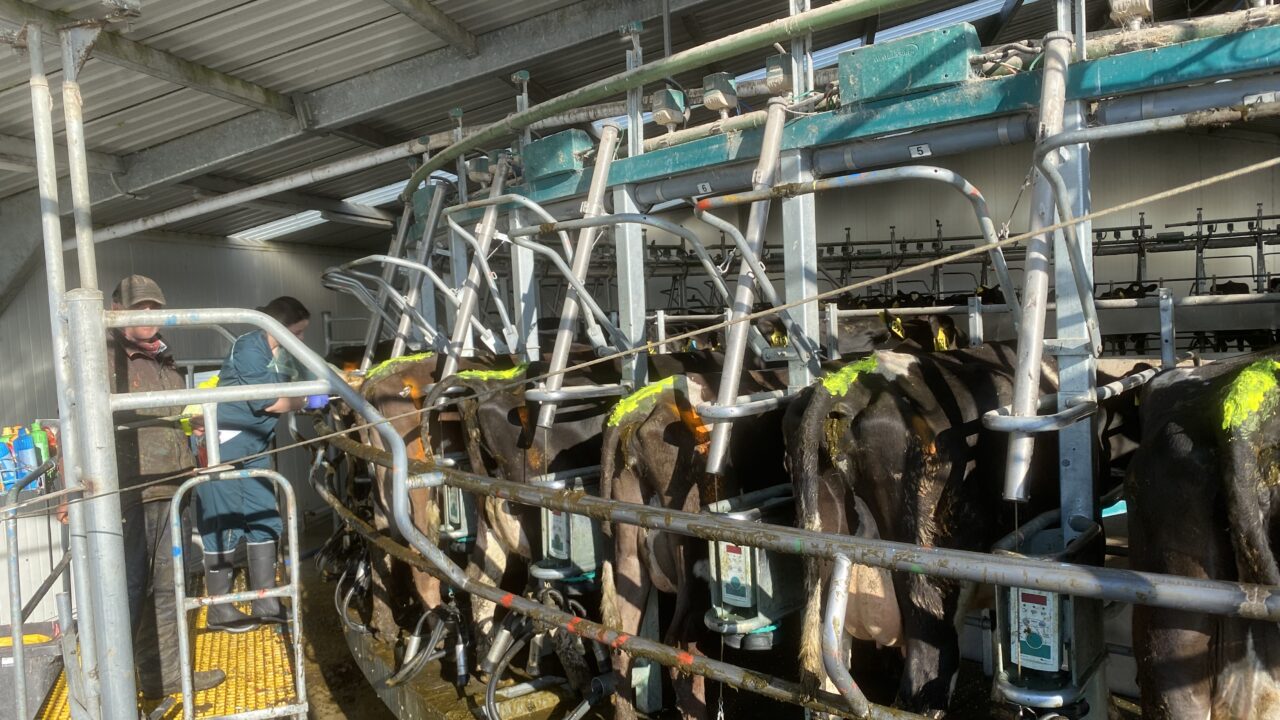
With the breeding season officially kicking off for many farmers this week, it is important to stay on top of heat detection.
There has been an influx of farms investing in heat detection technology in recent years, which does reduce labour massively.
However, it is important to not shut off completely to a point where you are not staying on top of reports and estrus tracking from that technology.
The same goes for farmers who are heat detecting with more traditional tools such as tail paint, chin balls, or scratch cards.
Taking your eye off the ball for even a couple of days can be costly.
Heat detection
The fertility of the national herd has improved massively in the last number of years, which is a significant advancement in Irish genetics but will be useless if accompanied by poor heat detection and missed heats.
Most cows will show signs of heat between the hours of 9:00p.m. and 7:00a.m., so relying on observation alone is not going to be sufficient and will lead to cows being missed.
The surest sign of a cow in heat is observing her standing when another cow is mounting her, unless the cow is visibly lame and unable to move.
Often the cow in heat will be doing a bit of mounting herself but this is not a sure sign alone.
Activity in the collecting yard or observation out in the field is effective but not sustainable, as farmers cannot be standing out in the field for hours watching cows.
Tail painting the cows is an effective way of achieving a high heat detection rate as, once the tail paint is well rubbed, it will indicate that the cow was standing to be mounted.
Tail paint should be applied in a narrow strip, about 2in wide and 9in in length along the tail head of the cow, and different paints should be used to identify the cow being served.
For instance, if you start by using blue paint to identify the first round of heats, once a cow is served, she should be tail painted a different colour such as yellow to indicate what is coming back around, repeating, and which cows are yet to be served at all.

Scratch cards and Kamar heat detectors are also handy tools to identify heats.
The Kamar heatmount detectors contain a built-in timing mechanism designed to be activated by standing heat behaviour, whereas the scratch cards will be scratched and rubbed when the cow has been mounted.
A sign that a cow is bulling is that she will not let down her milk when the cluster is put on, and she may be panting a bit more heavily and visibly unsettled.
If a cow comes into the parlour with scratches on her flank and tail head and wounds, quite often a grazed bit of skin either side of the tail, it is a sure sign that the cow has been involved in a lot of mounting activity throughout the day.
If clear mucus is present around the cow’s vulva and she looks well ruffled up with dirt and muck climbing her hocks and rear, it is a clear and obvious sign that she is in oestrus and that cows have been mounting her throughout the day.