Australian farmers warned of potential mouse ‘plague’
Grain growers in Western Australia and South Australia have been asked to provide evidence of mouse activity to assist in an emergency application for stronger bait.
This comes as the Commonwealth Scientific and Industrial Research Organisation (CSIRO) has noted it has been receiving “concerning reports of very high mouse numbers” in Western Australia.
According to CSIRO’s latest mouse report, the reports suggest “outbreaks could be under way across the (1) MidWest coast around Geraldton, (2) Central Wheatbelt around Merredin, and (3) Esperance region on the south coast”.
The report also noted that “strong evidence of moderate-high and increasing population densities from recent survey data” in Southern Australia indicates potential for an outbreak in that state as well.
Grain Producers Australia (GPA) has urged grain growers in Western Australia and South Australia to provide evidence of mouse activity after applying mouse bait.
The organisation said it needs grower observations and data to support its application for an emergency permit for use of mouse bait to the Australian Pesticides and Veterinary Medicines Authority (APVMA) “to address the mouse plague emergency situation”.
GPA research development and extension spokesperson, Andrew Weidemann said growers “needed access to higher dose zinc phosphate mouse bait to ensure consistent control of mice during this period of higher mouse pressure”.
“Mouse activity is building at a critical time for grain producers during seeding and early crop development,” he said.
“Growers currently have access to ZP25, but feedback from growers and evidence from research is that this strength bait does not convert to adequate control in the paddock.
“ZP50 requires mice to consume less of the baited grains to ensure a lethal dose, which is particularly important when mice have high amounts of background food available.”
Oppositition Alliance MP Lachlan Hunter, who acts as Shadow Minister for Agriculture and Food said the reports show mouse numbers surging, placing crops at “serious risk” just weeks out from seeding.
“Growers are reporting thousands of mice per hectare. This is not a minor issue, it is a full-blown plague, and the damage will be immediate if it is not brought under control.”
He called on Minister for Agriculture, Fisheries and Forestry Julie Collins to “urgently reinstate emergency approvals for ZP-50 so farmers can access the bait they need to tackle this crisis.”
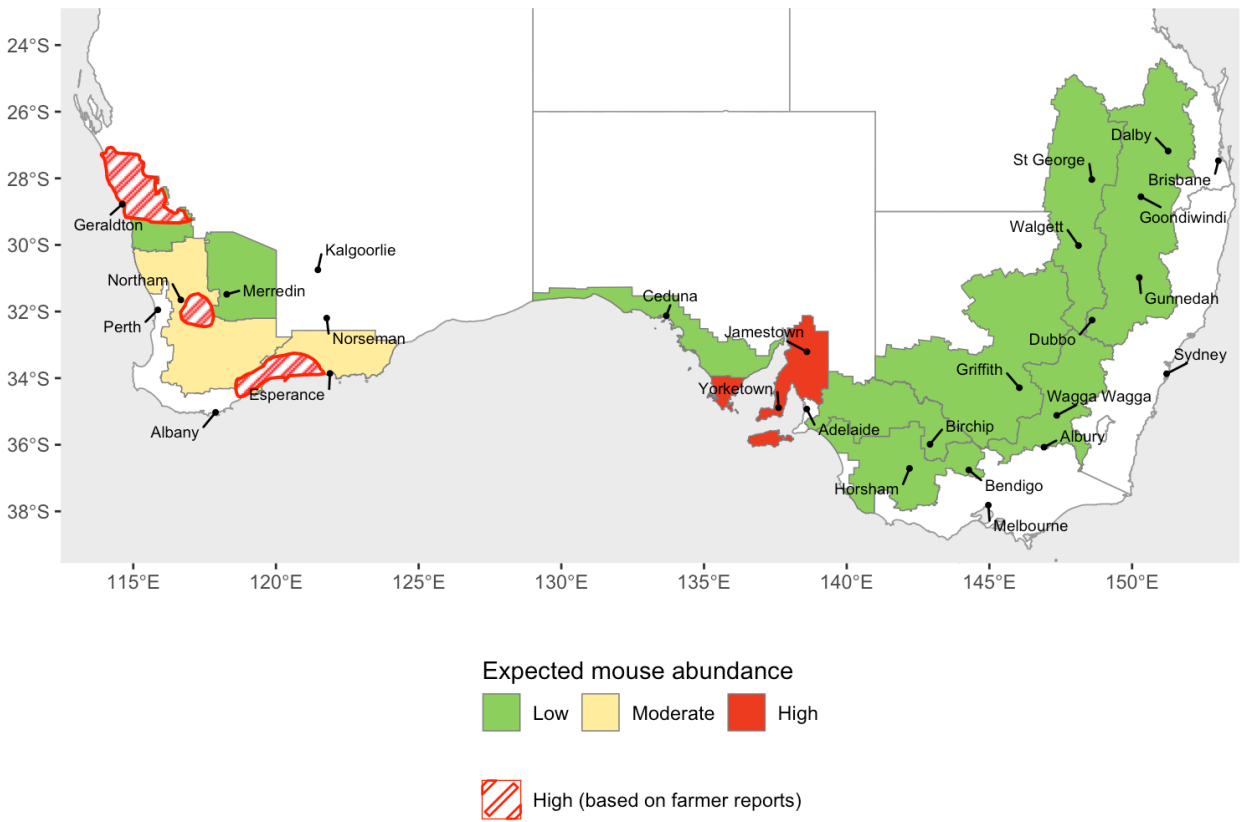
Monitoring detection data indicates:
- Low = mice detected at 33% of sites or less;
- Moderate = mice detected between 33 – 67% of sites,
- High = mice detected at more than 67% of sites.
Farmers throughout Australia’s grain-growing regions are being asked to log their mouse sightings through the CSIRO’s ‘MouseAlert’ app to help provide the information that researchers need to make predictions about future outbreaks of mice.

As stated by the CSIRO, “MouseAlert provides farmers and advisers with the opportunity to access information about mouse activity in their area at critical times during the cropping season to determine whether numbers are at levels that could pose a risk to crops.”
MouseAlert data has formed a baseline for comparison when monitoring mouse activity at “critical times of the year, such as during the crop growing phase in winter, and in spring to get an understanding of population size and breeding activity prior to harvest”.
Mouse plagues
In 1993, Australia’s worst ever mouse plague caused an estimated AUS$96 million worth of damage, according to the CSIRO.
The mice destroyed thousands of hectares of crops and reportedly attacked livestock in piggeries and poultry farms.
“They chewed through rubber and electrical insulation, damaged farm vehicles, and ruined cars and buildings,” the organisation stated.
Another plague in 2010 and 2011 was “almost as bad”, affecting three million hectares of crops in New South Wales and the Riverina regions, as well as parts of Victoria and South Australia.