Krone’s upgraded four-rotor rake allows for ‘even greater comfort’

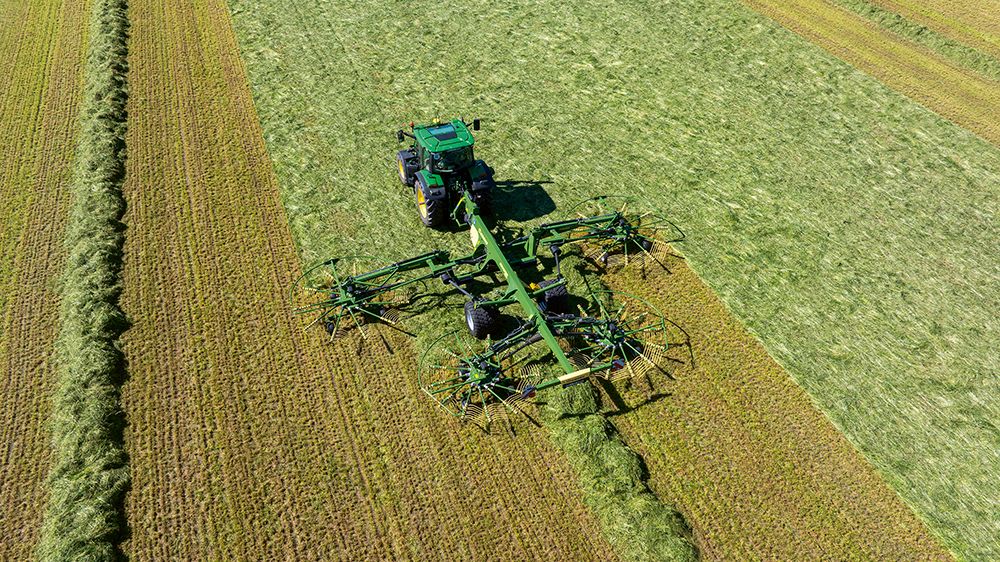
Krone is introducing an upgrade to its Swadro TC 1250 line with the new Pro version, claiming it's "even easier to operate".
This release will expand on the Swadro TC 1250 and the Swadro TC 1250 Plus four-rotor rakes.
The machine comes equipped with standard Load-Sensing hydraulics and an ISOBUS operation device.
According to Krone, the Swadro TC 1250 Pro offers "a range of additional functions which enable numerous automated processes".
These additional functions take operating comfort and efficiency "to a whole new level", it said.
Machine upgrades
With an overall length of 8.25m, the Swadro TC 1250 machines are compact four-rotor rakes.
The working width can be adjusted from 9.8m to 12.5m, allowing for swath volume to be adapted for the machine following behind the rake.
The Swadro TC 1250 Pro features Krone's EasyLine drive concept, a programme aimed at ensuring optimal forage flow.
The front rotors rotate faster than the rear ones, creating loose yet uniformed "box-shaped" swaths.
These allow crops to dry faster as air can get under the swath, while also preventing roping - when the crops are twisted into a thick, rope-like column, which may cause balers or harvesters to get choked up.
The active hydraulic rotor relief system, which was already a standard feature on the Swadro-models TC 1370 Pro and TC 1570 Pro is now also integrated into the Swadro TC 1250 Pro.
This system is integrated into the lifting cylinders to ensure optimum bearing pressure of the rotors. The system can be set separately for front and rear rotors, even while driving.
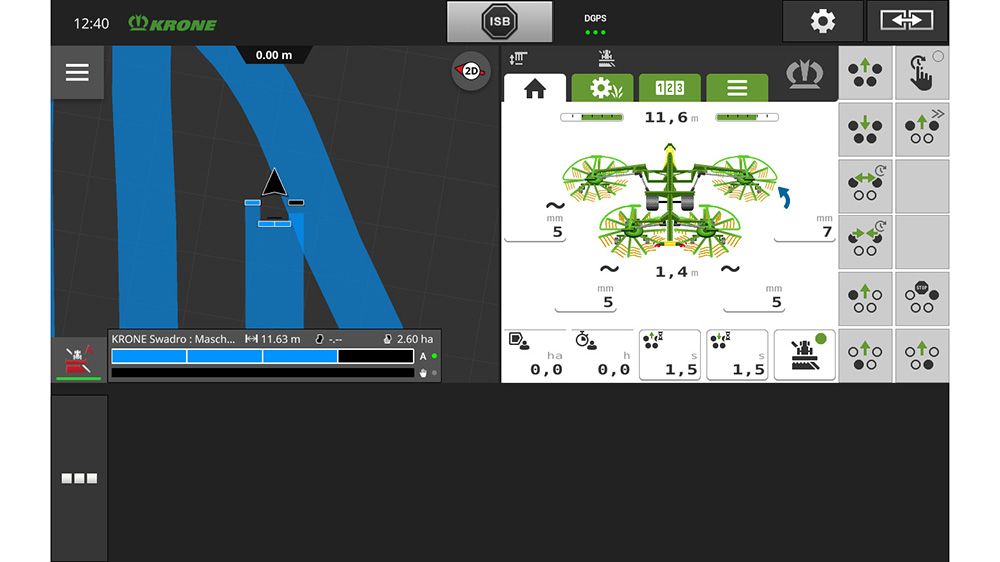
When adjusting the working/swath width, relief pressure is automatically adjusted by an active control system so the rotors are always evenly relieved.
According to Krone, even at the headland, the Swadro TC 1250 Pro's "sophisticated" hydraulic system demonstrates its strengths impressively.
"An integrated vibration damper enables the rotor arms to effectively absorb any fluctuations in the rake that occur when it is positioned at the headland," it said.
This includes those caused by uneven ground or swaths which have already been laid down.
The company claims this prevents the entire machine from rocking and significantly reduces the load on the frame.
In addition to the active hydraulic rotor relief system protecting the rake, the Soft-Down automatic lowering system protects the swath and tines.
"As the rotors are lowered from the headland position into the working position, they are cushioned just before they touch the ground, ensuring that they settle gently onto the sward."
This controlled lowering ensures that the rotors touch down safely and precisely, provides protection to the swath and minimises risk of crop contamination (from clay/dirt).
Automatic functions
The Swadro TC 1250 Pro comes as standard with a single-rotor lifting mechanism and a paired rotor-lifting mechanism.
When using the lifting mechanism, the rear rotors are automatically raised to the same height as the front rotors after a short delay.
If the rotors are still on the ground when reversing, the machine lifts them automatically. This prevents damage to both the rake and, in particular, the swath.
To further enhance driving comfort, the Swadro TC 1250 Pro is available with an optional automatic section control system.
This significantly reduces the driver’s workload, particularly when working on irregular field layouts and during long working days, as the machine now raises and lowers the rotors automatically to avoid already raked swaths.
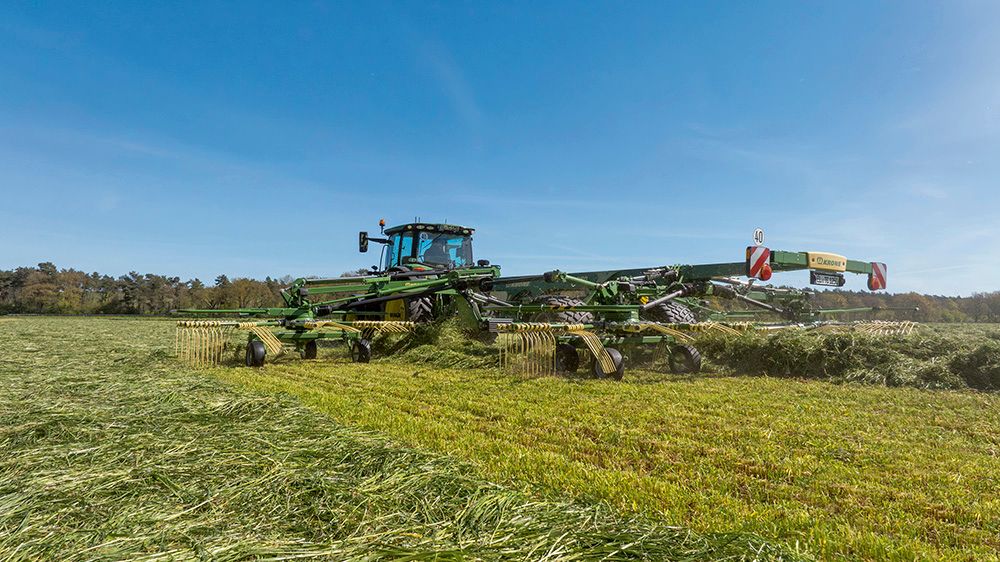
The rake can be folded from the transport position to the headland position and back again at the touch of a button using the sequence control.
According to Krone, when the machine is folded out, it automatically returns to the last position it was in before it was folded in, a notable update in terms of convenience.
Like the Plus model, the new Pro version also features electric rotor height adjustment.
Two programmable rotor heights enable quick switching between known conditions.
To adjust the height of the rotors individually, each rotor can be adjusted separately, all together, or using the master rotor principle via the terminal.