

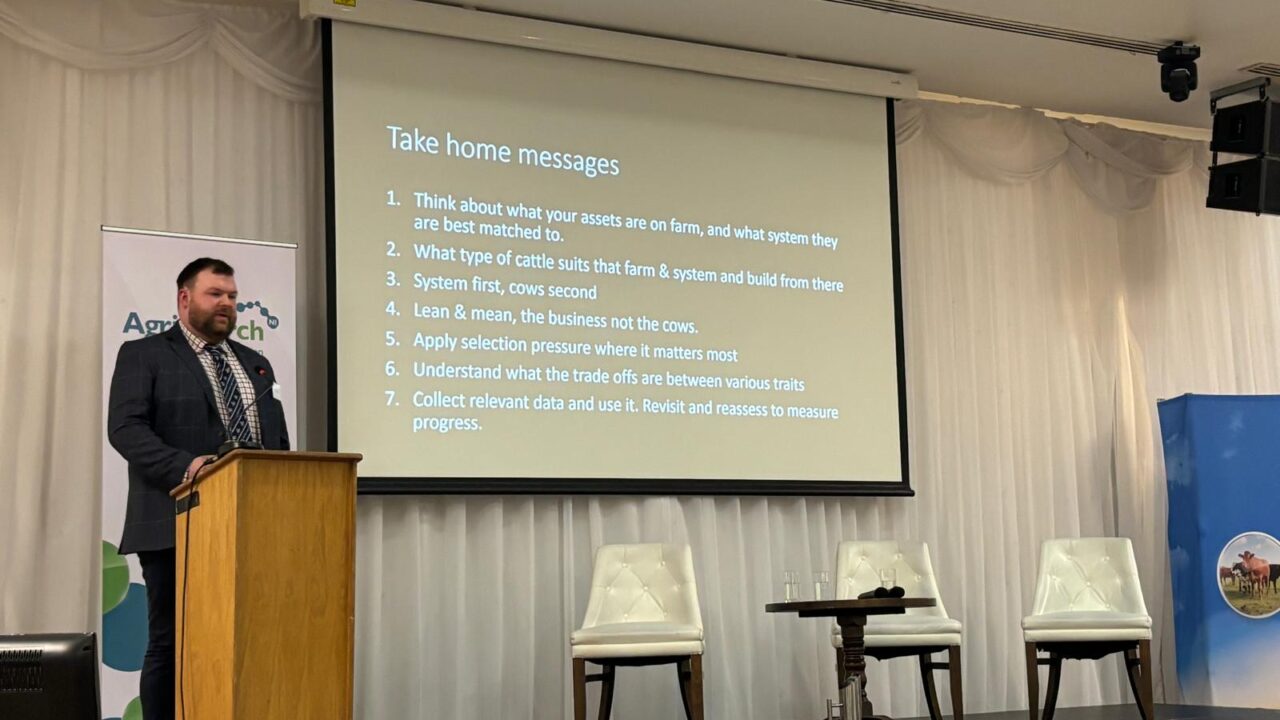
Based in Aberdeenshire, Scotland, Duncan Morrison is a farmer who, at 25-years-old, made the move to establish his own suckler herd – originally on a leased farm.
Since his humble beginnings starting out as a farmer in his own right, Morrison has grown his farm to 770ac and plans to move towards 300 suckler cows in the near future.
He said: “We took the plunge and bought a load of cows.
“We hit it lucky with certain things and built things up over a number of years. Probably 10 years now and it had to be done pretty cheaply because we just didn’t have the money.”
He noted that he was given finance from the local Livestock Mart when originally setting up – an arrangement which he said is “quite common in Scotland”.
“Most of the livestock markets and companies will have some kind of finance scheme where they will help young farmers out. You pay a small deposit and then you have to pay them over a couple of years.
“It gets you going. It helps us but it also helps them. In 2016 when I started the business, there was 1,000 cows leaving our area and that starts to hit the auction marts.
“It’s in their interests to help young people get back into the business. It works for both parties I think.”
The breed of choice for the herd is predominantly Angus and Stabiliser, which he says is “pretty low cost and low input.”
Commenting on why he chose these breeds, Morrison said: “First and foremost, they suit the type of farm we’ve got.
“One of our main assets is we’re quite a dry-type farm so it suits itself to outwintering and a lot of these continental-types don’t suit that job.”
Commenting on how he manages calving, he said assisted calvings are only “a few percent each year”.
Outwintering suckler cows
Morrison said that a number of methods have been trialled for outwintering the cows but that they have “settled on a system where we strip graze kale and use deferred grass.”
The deferred grass is shut off after silage has been cut in the summer months. Bales of hay and silage are placed in these fields and they are then grazed over the winter months.
He said: “I’ve found it’s much cleaner and we don’t get the same poaching and mess as we do with forage crops.
“We also have lots of deer where we are, and deer can really damage forage crops if they get in.”
Despite this, forage crops are still used for in-calf heifers and youngstock.
Morrison said that they are useful for snow because deferred grass gets covered “so the stock find it easier to eat things like kale and turnips in the snow”.
There are currently 260 suckler cows on the 770ac block with a third of the progeny retained for finishing, and a third sold as store cattle.
Of all the cattle on the farm, 150-200 are housed for the winter.
“We’re probably understocked because we took on ground last year and haven’t fully grown into it yet.”
Breeding and calving
All breeding stock get a mineral bolus in November, which generally covers them until breeding the following season. Cows also get mineral blocks.
Cows generally calve outdoors and Morrison aims to calve cows on a dry field with shelter and close to the farm so cows can be observed easily and problem cows can be taken in.
He said: “We calve in April, but we still get snow in April if we have a bad spring so you do need to cover your bases.”
Commenting on his ideal breeding cow, Morrison said: “Because our system is the way it is and the type of land we have, we’re generally looking for a medium-sized cow.
“I think you can go too small as well and you will land with a calf that’s maybe not all that valuable.
“On the other side of the coin, you have a cow that’s very expensive to keep and she doesn’t perform pound-for-pound the same as a smaller cow
“We’re looking for something in the middle, we’re round about 650kg across the herd so 650-700kg mature weight cows.”
All heifers calve at two years-of-age and Morrison has learned over the years how to better manage cows to calve at 24 months.
Interestingly, breeding stock receive no concentrates but some concentrate feed is used for growing cattle, stores and pedigree bulls.
“It’s very much a forage system,” he said.
Finishing and culling
There are 260 suckler cows on the farm currently and a third of the progeny are slaughtered and a third are sold as stores.
There are a range of systems used to finish cattle. 12-13-month bull beef finishing on barley is one of these systems. The target carcass weight here is 350kg.
Under-16-month bulls at grass is another system. Here, the target is for an ‘R3’ carcass with a 330kg carcass weight and Morrison said this system worked well when concentrates were expensive.
He said: “We’re moving more towards steers and heifers now finishing at 18-19 months.”
Heifer carcass weights are around 300kg with some lighter at 280-290kg and some heavier at 330kg.
Steer carcass weights are generally from 300-350kg.
The calving season goes on for 6-7 weeks on the farm generally.
Morrison said that there are currently 260 females in the breeding herd.
“We took on a new farm last year so we will probably be moving towards 300 breeding females in the next year or two,” he explained.
“If we can keep them easy kept, adding a few numbers won’t make any difference.”
The key performance data being monitored includes: The number of calving assists; birth weights; mortality; in-calf rates; weaning weights and cow body condition scores.
From this and additional data, Morrison works out the performing and non-performing cows.
Cows are culled on issues including:
- Lameness;
- Teats;
- Udders;
- Temperament;
- Fertility.
Morrison said: “We are trying to eliminate problems when culling our cows.
Weaning starts in October and quiet wean paddles are used when weaning calves off cows.
Advice to young suckler farmers
When asked what advice he would give to young farmers trying to get established, Morrison said: “It’s a good time to be involved in the job.
“I think there’s hardly a better job to be in at this time.
“I would just say go for it. It can be done. A lot of people told me it couldn’t be done and it can be.
“But you need to be good at it. Although there’s money in it, there’s a lot of cost and if you’re not paying attention, you can land no better off so you need to pay attention to your costs, hit all your KPIs, do the job right and you’ll make money.”
Related Stories

Rural Focus revisit: Oldcastle brothers in the butcher business

Listen: Growing a suckler herd to 300 cows on 770ac in Scotland

Listen: Young farmer with 170 cattle on a 100% leased farm
.editor-styles-wrapper .wp-block-acf-related-stories-block {
max-width: 960px !important;
background-color: var(–color-gray-default);
padding-inline: 40px;
padding-top: 8px !important;
padding-bottom: 20px !important;
}
