

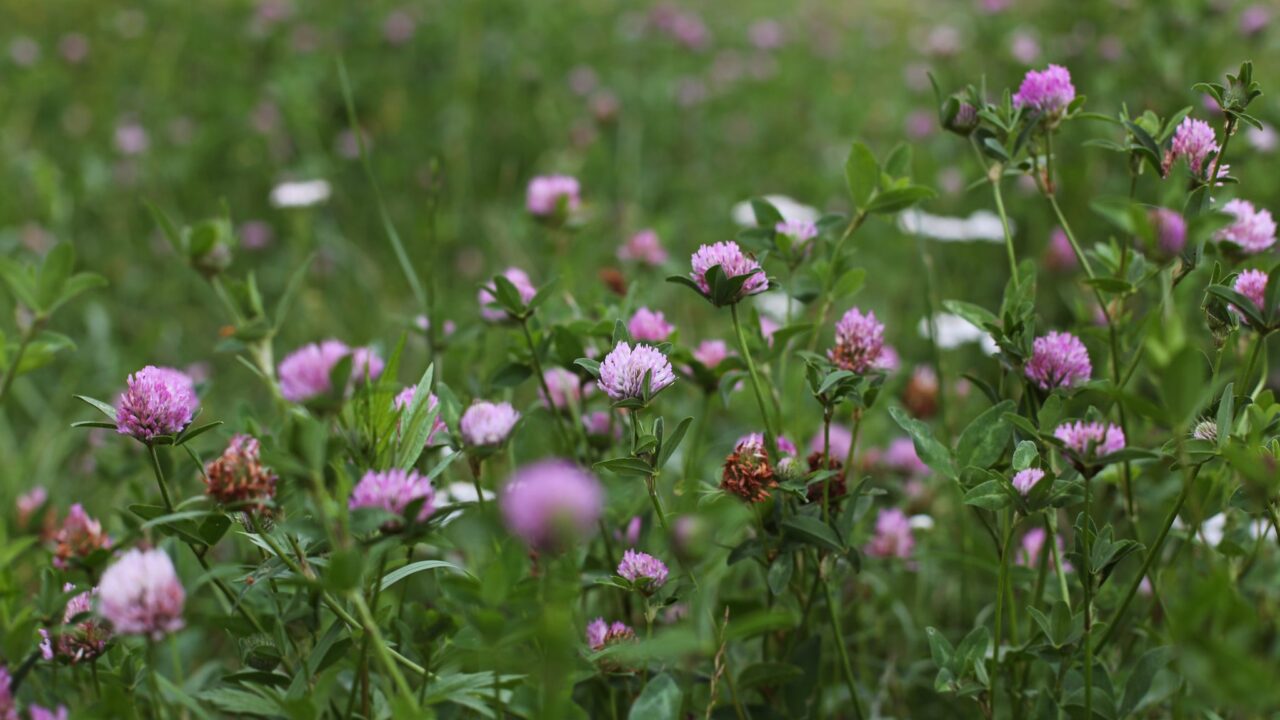
The Potash Development Association (PDA) has just published a technical update reviewing how clover yields in grass swards can be optimised.
Legumes are affected by soil pH and require the same conditions as grass: in other words, a pH range of 6.0-6.5.
If grown under acidic conditions, clovers may not nodulate effectively and their ability to fix nitrogen is reduced, according to PDA.
In fact, at very low pH levels, clovers may fail to nodulate completely, the association said.
Potash
Potash is important for keeping a good proportion of clover in a sward. A good mixed grass/clover sward needs more potash than grass alone does.
Field experiments over three years where herbage was either cut and removed or grazed showed the effect of applied potash on clover yields.
Where 70kg of potassium oxide ha was applied each year, clover dry-matter yield was increased by 53% on the grazed sward and by 72% where the herbage was cut.

Meanwhile, clovers can require significant amounts of phosphate due to the role this nutrient plays in root development, nutrient uptake and growth.
Furthermore, as phosphate is a vital component of the ‘energy compounds’ within a plant; and as the fixation of atmospheric nitrogen is an energy hungry process; its efficiency is heavily reliant on plants having access to sufficient levels of the mineral.
Potash is very important in the microbiological fixation of nitrogen by root nodules in legumes, therefore is also an important nutrient for herbal leys, especially those which contain a large proportion of legumes.
Sulphur
Clover, along with all legumes, also has a higher requirement for sulphur than grass.
Sulphur supply is linked to nitrogen fixation and deficiency results in reduced nodulation, inhibition of nitrogen fixation, and a slowing down of nodule metabolism.
More generally the role of sulphur in determining crop yields and performance continues to be recognised.
And there is a close link between the role of sulphur and nitrogen in this regard.
Both elements are crucially important for protein synthesis.

As a rule of thumb, a plant’s sulphur requirement is one twelfth the value of the equivalent nitrogen figure.
This concept would still apply in principle to legumes, although the amount of ‘applied’ nitrogen is not known.
This is due to the legume’s ability to fix nitrogen from the air.
In addition, brassicas have a much greater sulphur requirement.
This is due to the numerous sulphur-containing compounds by all the members of the brassica family. This is why crops such as oilseed rape have a much closer N:S ratio.
