

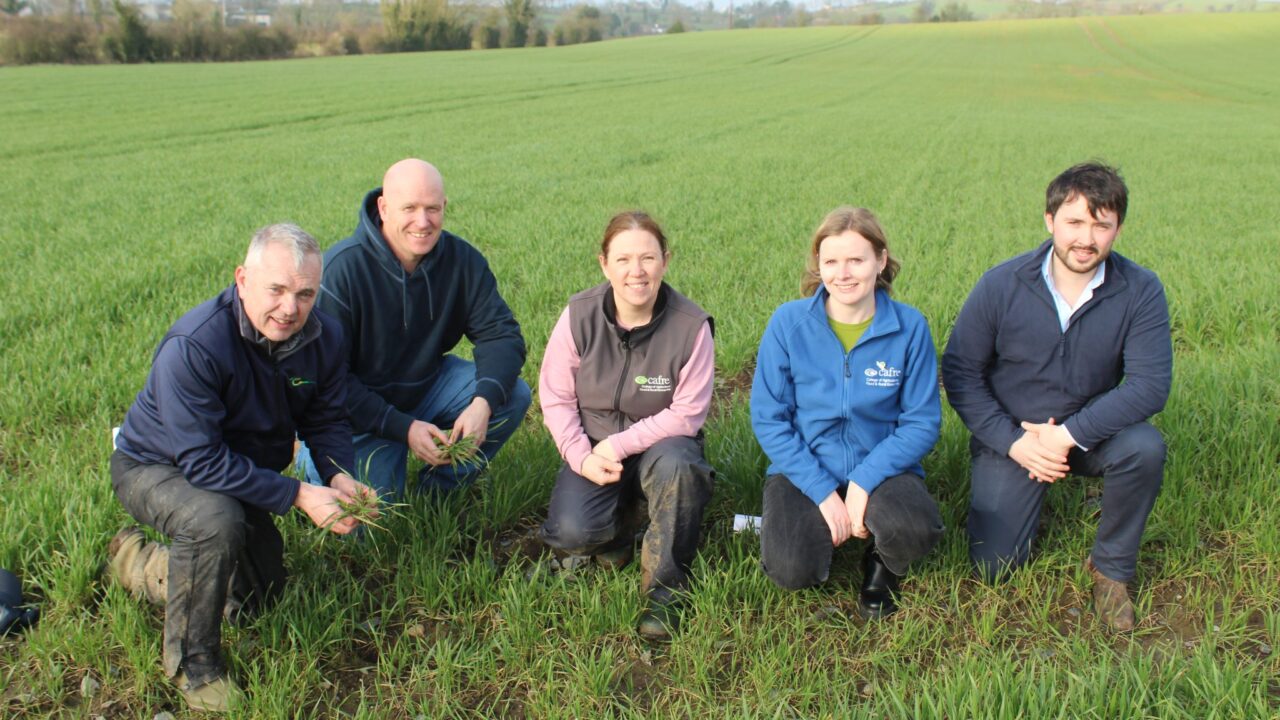
Members of a CAFRE Business Sustainability Group (BSG) had the recent opportunity of walking winter wheat and barley crops in the Newry/Rathfriland area of Co. Down.
The host farmer was Shaw Hanna, who grows a mix of winter wheat, barley and oilseed rape in the south Co. Down area.
Teagasc tillage specialist, Shay Phelan, took part in the event.
Note was take of the very advanced growth stage achieved by the September-planted crop of Palladium winter wheat, which was fast approaching stem extension.
Phelan specifically noted that the crop had received a pre-emergence herbicide.
He added: “Generally, winter cereals crops have performed well over recent weeks, despite the consistent rain that has fallen across the country since the beginning of the year.
“This may well reflect that they were planted out in almost perfect conditions back in the autumn.
“One very serious downside to the deterioration in ground conditions that became a reality as last autumn progressed was the lack of opportunity that many growers had to use a pre-emergence herbicide on their newly established cereal crops.”
According to the Teagasc representative, a key challenge now confronting Ireland’s tillage is effective control of weeds.
“Many grassland weeds are now resistant to a selection of herbicides, including annual meadowgrass, wild oats, many of the bromes and blackgrass,” Phelan explained.
“And we are seeing this trend now becoming apparent in broad leaf weed species.
“The best way of securing the level of weed control that growers want to achieve in winter crops is through the effective use of pre-emergence herbicides.”
The use of pre emergence products ensures that weeds are tackled at a young growth stage, according to the Teagasc specialist.
“We need to protect the herbicide chemistries that are available right now. In practical terms this means applying products at full rate,” he said.
“There is also case for applying a mix of two herbicides at the same time – both at their recommended application rates.”
Pre-emergence herbicides
Teagasc research indicates that the need to apply pre-emergence herbicides is particularly acute, where winter barley is concerned.
“A traditional spring tidy up with the herbicides currently available will no longer deliver strong weed control,” Phelan warned.
“The supply of new herbicide chemistries coming to the market is fast diminishing. This is why we must protect those herbicide options that are currently available.
“It is costing cereal growers in England up to £150/ha to control blackgrass infestations alone.
“This is the real cost of herbicide resistance that could be coming Ireland’s way if the appropriate preventative measures are not taken.”
