

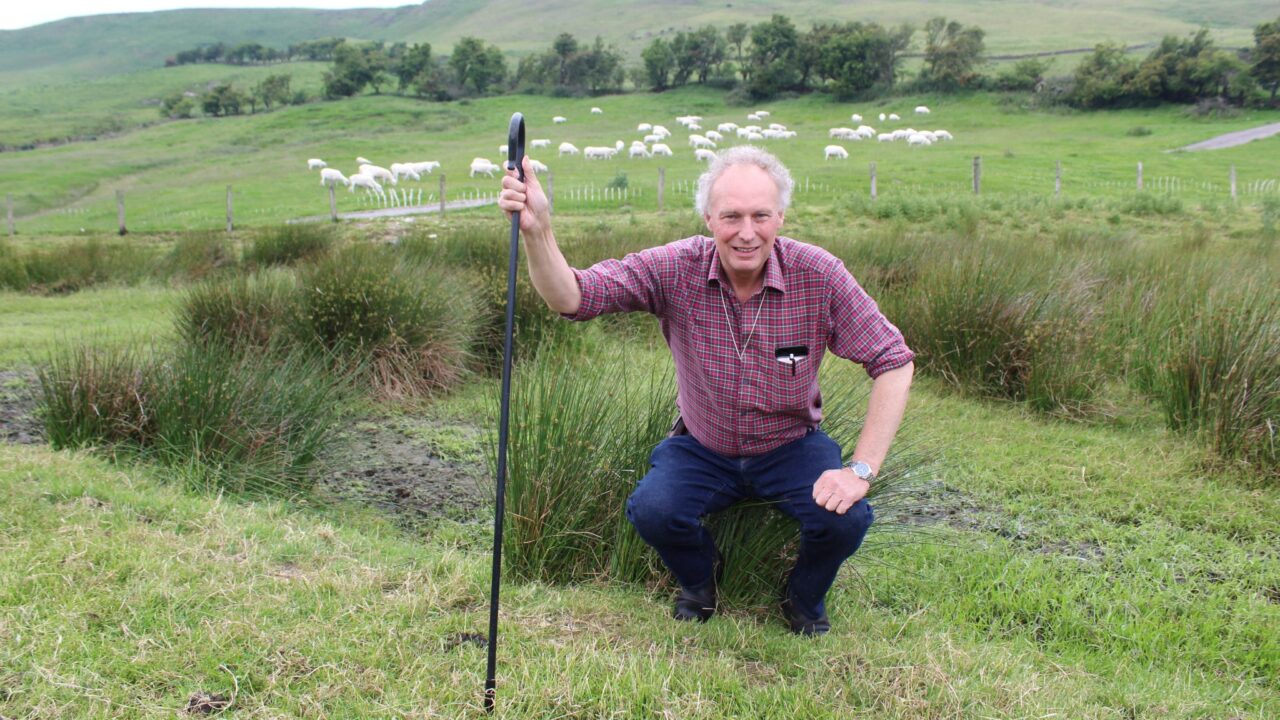
Leading EasyCare sheep breeder, Campbell Tweed, vaccinated all his breeding ewes and rams against bluetongue in January.
The Co Antrim flock owner spoke to Agriland about his decision.
He said: “Given what we know about the extent of the bluetongue challenge that exists within the restricted areas established last autumn, following the outbreak of the disease in Co. Down, I felt that vaccinating my sheep was the obvious step to take.
“It is now clear to me that cattle and sheep in many parts of Northern Ireland could face a significant bluetongue threat, once temperatures start to warm up and midge numbers start to increase.
“We vaccinated the sheep at the same time as they were being fluked.”
The bluetongue vaccine is applied as a single dose, injected subcutaneously.
Campbell Tweed outlined that the licensing arrangements with the Department of the Agriculture, Environment and Rural Affairs and the procurement of the vaccine stocks required were co-ordinated through a local veterinary practice.
“Sheep affected with bluetongue can display a number of symptoms,” he said.
“Given the impact of the disease in England up this point, a fall-off in fertility is most likely here in Ireland. However, it remains to be seen what will occur.
“Bluetongue is a health challenge for sheep and cattle that we never wanted to see arrive in Ireland. But now it’s here, the task in hand is to manage the problem as best we can.”
Significantly, Tweed is confirming that the arrival of bluetongue has not halted the movement of sheep for direct slaughter from Northern Ireland either across the border or to the rest of the UK.
He commented: “It is yet to be determined how the export of breeding sheep from Northern Ireland will be impacted into the future.”
Diseases
According to the EasyCare flock owner, the arrival of bluetongue, following on from Schmallenberg, is part of a continuing process that will likely see Irish agriculture impacted by the arrival of other diseases.
“This is a direct result of warming temperatures and the continuing impact of climate change across Europe,” he said.
Tweed firmly believes that a greater focus must be placed on research into production diseases that can and will impact on farming across the UK and Ireland into the future.

These diseases will likely be difficult to deal with and farmers will need the good advice, the sheep farmer said.
“Given current circumstances, it is now important that the public purse is once again used in a meaningful way to give good independent advice,” he stressed.
“There is also a risk that these disease could be zoonotic: they can affect people as well as animals.”
Meanwhile, Tweed is indicating that Minister for Agriculture, Andrew Muir, and staff within the Department of Agriculture, Environment and Rural Affairs (DAERA) are open-minded regarding the development of a bespoke sheep support policy for Northern Ireland.
He explained: “Two issues remain to be fully resolved: the identification of a suitable policy vehicle and the securing of the required funds.”
Northern Ireland sheep industry
The Co, Antrim sheep producer is a member of Northern Ireland’s Sheep Task Force.
“Breeding ewe numbers have reduced significantly over recent years,” he continued.
“This trend reflects a number of factors: an ageing farmer population, the seasonal time pressures, particularly around lambing, for those farmers who want to keep sheep on a part-time basis.”
Tweed highlighted that a decade ago, Northern Ireland was home to “some 1.2 million ewes”.
“Today the figure stands at around 800,000 head,” he said.
“Objective number one is to stabilise lamb production and have a secure critical mass.
“We need a core number of breeding ewes in order to make this happen. And we are there now.
“Looking to the future, I firmly believe there is scope to expand the sheep industry on a sustainable basis.”
Tweed believes that lamb production can deliver for society as a whole from two points of view: their ability to enhance the conservation value of production agriculture and the fact that the animals can produce high-quality protein from a landscape that could otherwise not be used to produce food at all.
Value for society
He added: “Sheep rank second only behind dairy cows in terms of their ability to transform forage into a high-quality protein source as part of a balanced, human diet”
He said that food security “has dropped down the pecking order of successive governments’ priorities over recent times”.
“Hopefully, this state of affairs is now changing back towards a more focused perspective on the role that production agriculture plays for society as a whole and the contribution it makes to the Northern Ireland economy.
“But sheep are unique in doing so much for both the environment and food security.
“The sector needs to be supported on a sustainable basis into the future.”
Support
But what is the best support vehicle that will meet the needs of sheep farmers in Northern Ireland?
A form of headage payment might seem the obvious option.
“I am not sure if such an approach is a runner given the current commitment by DAERA to the new suckler cow scheme and the beef carbon reduction measure. Both are cattle headage payments,” Tweed commented.
Northern Ireland’s new Sustainable Action Programme (SAP) has two core objectives: a reduction in greenhouse gas emission levels across the sector in tandem with a commensurate increase in farm productivity.
So, it is safe to assume that a new sheep support measure would be fully aligned with these principles.
In terms of the monies required, based on a equivalent payment per breeding ewe of £20, a budget of £16 million would be required on an annual basis.
Growing popularity of EasyCare sheep
Tweed confirmed that EasyCare Sheep Ireland (ESI) now has 200 people aligned to the group.
“This is an all-island figure,” he added.
“And there is every prospect of this figure increasing.
“Increasing numbers of sheep farmers are becoming repeat customers for the breeding ewes and rams available for sale from my Ballycoose flock.”
Refresh and renew are the themes that have hallmarked the breeding policies enacted by Campbell and his commitment to his EasyCare flock, which continues apace.

Last autumn saw 150 Ballycoose ewes inseminated with NZ Wiltshire semen, specifically sourced from high performing rams bred in Southland, New Zealand.
“New Zealand Wiltshire bloodlines are polled sheep with high growth characteristics and equally strong self shedding and easy care capabilities,” Campbell said.
“They represent the perfect complement to that range of genetics already available in the Ballycoose flock.”
The Wiltshire semen was used in 18 Ballycoose ewe families, with first lambs from last autumn’s mating programme expected to be on the ground by mid-April.
“The initial plan will be to evaluate and use the genetics more widely within my own flock before offering any stock for sale.”
The Ballycoose flock is home to a selection of the most progressive EasyCare bloodlines available in the UK and Ireland.
Performance recording all the sheep born on the Tweed farm over many years through both the Signet and Sheep Ireland programmes has been at the heart of this ongoing success story.
“EasyCare sheep are synonymous with wool shedding. But this is only part of the story,” Tweed said.
“At the very heart of the Ballycoose development programme is an absolute commitment to breed ewes that perform well, making best use of grass, maintaining the highest levels of animal health, and lambing each year outdoors with the absolute minimum level of human intervention.
“And it is the results generated from the flock recording programmes and rigorous selection that have allowed this to happen.”
