

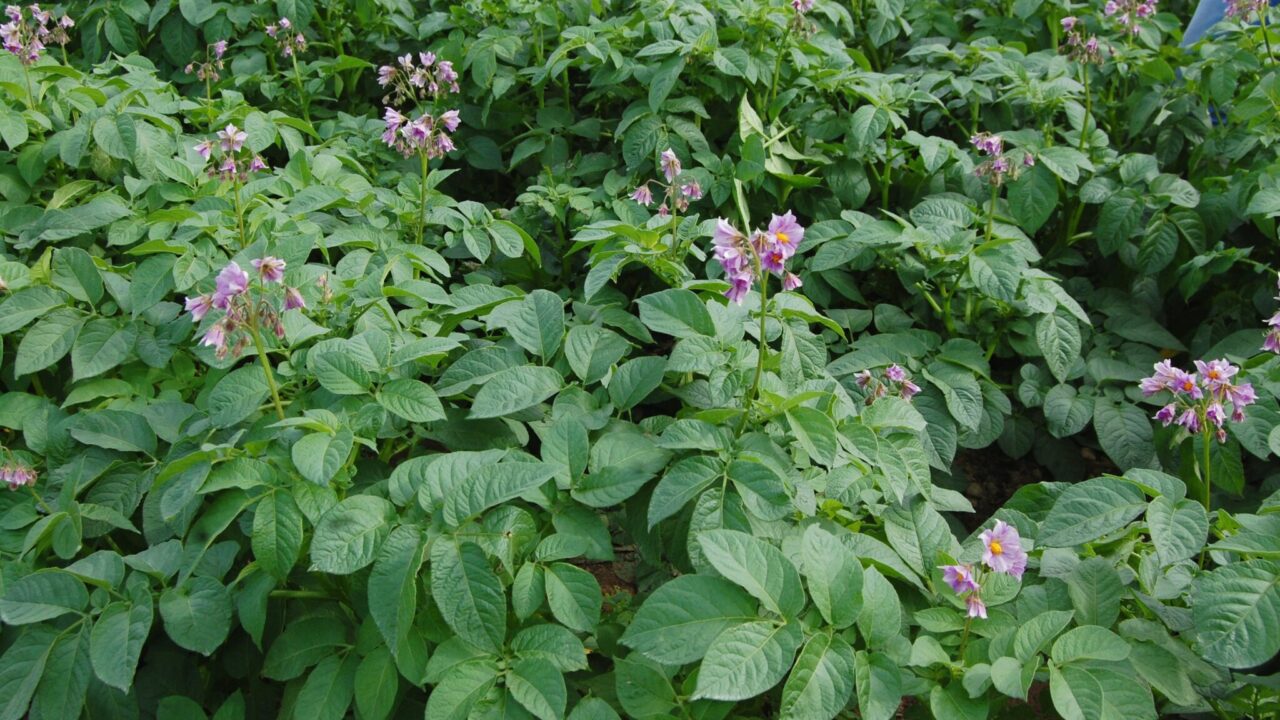
The Potash Development Association (PDA) has published a new potato crop nutrition guidance leaflet to facilitate UK and Irish growers.
Phosphate, potash and sulphur are very important nutrients for potatoes affecting yield, quality and profitability.
The new crop guide provides an updated overview of how these key nutrients interact to boost potato yields and tuber quality.
It provides guidance on best practice where crops are being produced for different markets, for different anticipated yields, and where the crop is grown on different soil types.
Due to the responsive nature of potatoes to phosphate, the restricted root system of the crop and the low mobility of the nutrient in soil, phosphate recommendations are significantly greater than crop offtakes.

Appropriate phosphate fertilisation for the potato crop is likely to leave surplus soil phosphate levels for the following crops.
Potatoes take up more potassium (K) than many other arable crops.
In the six weeks after plant emergence, the crop will take in at least two thirds of the total K uptake.
During peak vegetative growth, potatoes may require 10kg of potassium oxide (K2O) per hectare per day from the soil solution – in other words, to be released from exchange sites.
Potash
Maincrop potatoes contain the maximum quantity of potash in late July / early August and this may be more than 500kg K2O/ha for high yielding crops.
As the tops die back and the plant matures, some potash is returned to the soil.
By harvest more than 75% of the maximum K uptake is found in the tubers, which typically contain around 5.8kg K2O/t of harvested crop.

For the determination of nutrient removal, this figure is assumed to be constant over the normal yield range.
Moreover, from the potash offtake figure it is possible to calculate the maximum K uptake by the crop.
For example, a crop yielding 40t/ha will remove approximately 230kg K2O/ha. But this is only about 75% of the maximum supply needed.
Meanwhile, a crop yielding 70t/ha will have needed a maximum available supply of over 540kg/ha.
Varietal and husbandry improvements have resulted in a continual increase in potato crop performance levels.
For second earlies and maincrops, yields have increased from around 20 t/ha in 1960 to approaching 50 t/ha in recent years.
This has an important implication for potassium supply because it needs to match this increased level of production.
Potassium
All soils contain large quantities of phosphate and potassium but only a small proportion of this is available for crop uptake in a season.
Potassium is held by the clay minerals and organic matter in soil and is not leached or lost in the same way as nitrate and sulphate.
On the lightest textured and shallow soils some potash may move down the profile from the topsoil to a greater depth than can be reached by the roots of shallow rooting crops.
However, in the majority of soils, if more K is applied than is removed in the harvested crop, the excess will simply increase the amount of soil K reserve for following crops.
If offtake is greater than the quantity applied, soil reserves will be depleted.
Hence normal manuring policy is to identify the appropriate level of soil K for the individual soil type and calculate potash use to maintain it, primarily by replacing the quantity of K removed in the harvested crop.