

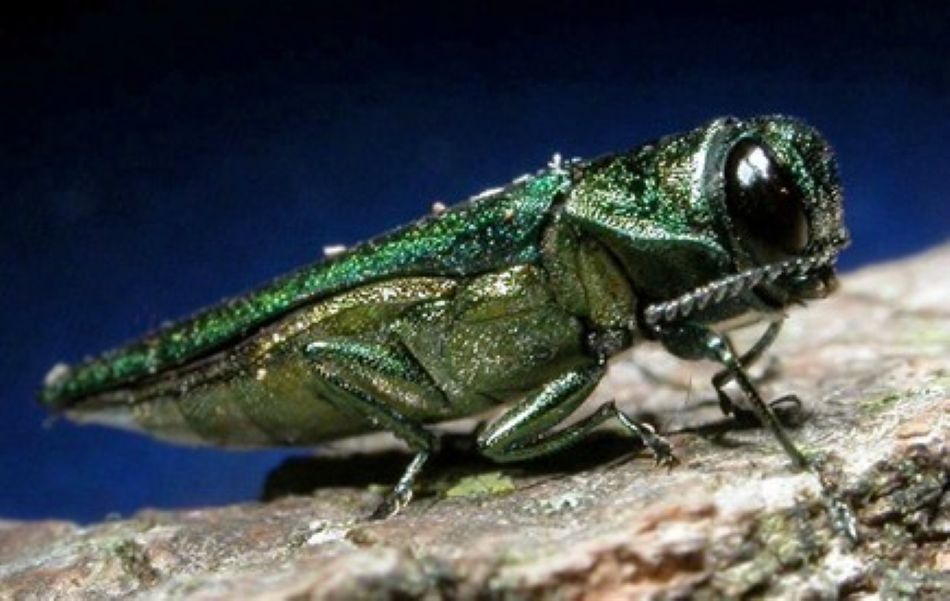
A new study from Rothamsted Research has shown that quick action by land managers could play a critical role in slowing the spread of the emerald ash borer if the pest reaches Great Britain.
Ash trees are currently under significant pressure from ash dieback, which is expected to cost the UK up to £15 billion over the next century, according to Rothamsted scientists.
British foresters could soon face another threat in the form of the emerald ash borer, which is an invasive beetle that has been responsible for the death of millions of trees across North America and Eastern Europe.
The new research – led by scientists at Rothamsted Research in collaboration with University of Warwick, Forest Research, University of York and the Stockholm Environment Institute – examined how both biological factors and quick responses from land managers could influence the course of an emerald ash borer invasion of Britain
Dr. Vasthi Alonso Chávez of Rothamsted Research noted that the strong presence of emerald ash borers in North America shows that the pest is “exceptionally hard to manage once established”.
“Our study shows that the way that land managers inspect, report and act on invasive threats has a very important role to play in tree health surveillance strategies.”
Researchers combined a biological model of emerald ash borer arrival and spread with a dynamic model of land managers’ decision-making, which was based on interviews, workshops, and survey responses from more than 400 stakeholders.
The study investigated how different forms of surveillance and management could impact a potential emerald ash borer invasion across three contrasting landscapes, including Kent, Suffolk, and North Wales.
Using simulations, the scientists assessed how the invasive species might be detected and managed under three different surveillance scenarios.
Findings
The simulations focused on the following surveillance scenarios:
- Targeted trapping at high-risk locations – Traps placed by officers at ports and firewood depots were found to have helped delay the spread of the invasive species in some cases, however “trapping alone rarely lead to eradication”;
- Routine tree health and safety inspections – This type of surveillance “proved to be important” in slowing the spread of emerald ash borers locally, although the pests were typically detected when trees were already in decline;
- Voluntary surveillance by land managers – This method “appeared to have great potential” for emerald ash borer detection, but participation reportedly depended on land managers’ awareness, confidence and cost, with financial support for traps significantly improving the chances of eradication in some scenarios.
Researchers outlined that early detection of the emerald ash borer is difficult as the larvae can stay inside trees for several years before symptoms appear.
Throughout the study, complete eradication of the species occurred in less than 1% of the standard simulations, underlining the difficulty in eliminating pests with long hidden phases and the ability to spread over long distances,
Land managers
Rothmasted Research stated that the study demonstrates how land managers will often be “the first line of defence” against a potential emerald ash borer invasion
According to the scientists, regular and accurate tree inspections from land managers is important for reducing the spread of the species even when eradication is unlikely, as it will “protect neighbouring sites and support coordinated control.”
The research highlighted clear guidance, trusted reporting routes, and financial support as key factors in sustaining long-term engagement with land managers and other stakeholders.
Rothamsted Research said: “Emerald ash borer, if it arrives, will be difficult to manage.
“But this research shows that collective action by informed and supported land managers can make a measurable difference to the future of ash in Great Britain.”