

UKHSA Amber cold weather health alerts are in place for all regions of England until Sunday, January 11.
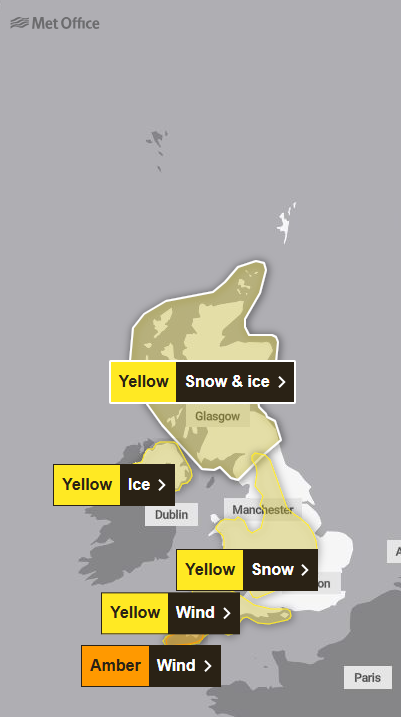
A number of severe weather warnings remain in place, with cold air leading to the potential for further snow accumulations in Scotland, and a widespread risk of ice across much of the UK.
Amber warnings are in place for snow in northern Scotland and a yellow warning for snow and ice is in place for the whole of today (Wednesday, January 7).
Aberdeenshire Council has stated: “We are looking at a prolonged period of significant impacts and as of today Aberdeenshire Council has declared a major incident.”
The current cold snap is set to continue according to the Met Office, before a deep area of low pressure threatens to bring further snow, strong winds and heavy rain to southern parts of the UK from Thursday night.
Meteo France has named the low Storm Goretti, as the worst of the wind impacts are expected to be felt across northern France.
Cold arctic air remains in place across the UK, with multiple warnings in force.
Last night was the coldest night of the winter so far, with temperatures falling to as low as -12.5°C in Marham, Norfolk, while Santam Downham in Suffolk, and Topcliffe, North Yorkshire, both saw a low of -10°C.
Yellow warnings for ice have been issued for Northern Ireland, Scotland, and much of England and Wales for overnight Tuesday into Wednesday morning.
Met Office Chief Forecaster Jason Kelly outlined that Wednesday will be dry for many with sunny spells.
Scotland and some western areas may still see some scattered wintry showers and a yellow warning for snow and ice will remain in northern Scotland.
Things will continue to feel very cold, although a touch milder than recent days with strong winds and coastal gales developing in some central and eastern areas of northern Britain.
Storm Goretti
Storm Goretti may bring a spell of very strong winds for a time on Thursday evening, with a risk of damage and disruption, according to the Met Office.
The storm may bring a short period of exceptionally strong north-westerly winds to the Isles of Scilly and parts of Cornwall on Thursday evening, with peak gusts potentially of 80-90mph in exposed areas.
This will depend on the exact track of Storm Goretti, and should the low pressure system track further south then the risk of these very strong winds would reduce.
Injuries and danger to life is likely from large waves and beach material being thrown onto coastal roads, sea fronts and properties.
Flying debris is likely and could lead to Injuries or danger to life and the Met Office added that there may be some damage to buildings, such as tiles blown from roofs.
Longer journey times and cancellations are also likely, as road, rail, air and ferry services may be affected, with some roads and bridges likely to close.
There is a good chance that power cuts may occur, with the potential to affect other services, such as mobile phone coverage.
What to do
Driving in these conditions can be dangerous, for yourself and other road users.
If you must drive, you can do this more safely by taking the following actions: drive slowly to minimise the impact of wind gusts; be aware of high sided vehicles/caravans on more exposed roads; and be cautious when overtaking, and give cyclists, motorcyclists, lorries, and buses more room than usual.
Being outside in high winds makes you more vulnerable to injury. The advice is to stay indoors as much as possible.
If you do go out, try not to walk, or shelter, close to buildings and trees. In advance of high winds, check for loose items outside your home or farm and secure them. Items include; bins, garden furniture, trampolines, tents, sheds, and fences.
If you are on the coast, stay safe during stormy weather by being aware of large waves. Even from the shore large breaking waves can sweep you off your feet and out to sea.
Take care if walking near cliffs; know your route and keep dogs on a lead. In an emergency, call 999 and ask for the Coastguard.
The Met Office said that people cope better with power cuts when they have prepared for them in advance.
Consider gathering torches and batteries, a mobile phone power pack and other essential items.
Stay up to date with the weather forecast for your area and follow advice from emergency services and local authorities.