

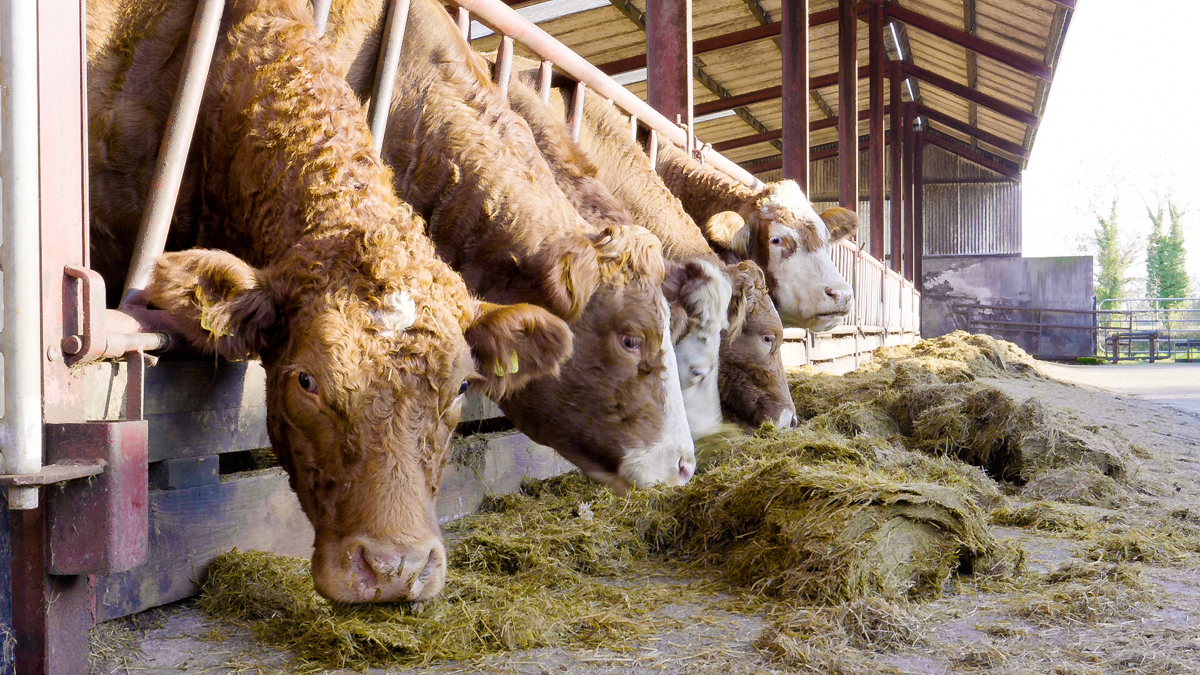
The steak on your plate and the milk in your coffee could soon have a smaller environmental footprint, thanks to a new €4 million EU-funded project exploring how we feed farm animals.
Led by the University of Reading, ‘Future feeds for sustainability in European livestock production’ (FEATURE) will test alternative feeds for Europe’s livestock.
The aim is to support the production of high-quality food in ways that are better for the environment and for animals, and more resilient to future challenges.
Livestock feeds
Currently, European livestock farming relies on a narrow range of feeds including ryegrass, cereals and imported protein-rich feeds.
However these sources face mounting environmental and economic challenges from climate change, pollution and unstable prices.
FEATURE will investigate alternatives including mixed grasslands with herbs and legumes, co-products from the agri-food sector and new protein sources.
Researchers will examine how these feeds affect animal health, digestion and productivity, and how they influence the taste and nutritional quality of meat, dairy and eggs.
Prof. Sokratis Stergiadis, who leads the research at the University of Reading, said: “What sets FEATURE apart is its whole system approach.
“We are looking at everything from how animals respond to different feeds to what this means for farmers, the environment, food quality and consumers.
“The project combines laboratory research, on-farm studies, life cycle assessments and close collaboration with the farming and feed sectors.
“This can deliver solutions that are practical and ready for use, reducing Europe’s dependence on imported protein and cutting the environmental footprint of livestock farming.”
A new generation of agri-food scientists
As part of FEATURE, 13 doctoral researchers from different partner institutions will work across the network to tackle questions spanning animal nutrition, food quality, environmental impact and economic viability.
Their training will cover laboratory work, on-farm studies, sustainability assessment, communication and project management, and develop skills in entrepreneurship, innovation, open science and research integrity.
The aim is to equip the next generation of agri-food scientists to work across disciplines and sectors, delivering practical solutions for the whole agri-food chain.
The partnership
FEATURE begins this month (January 2026) and will run for four years.
The project brings together leading agricultural and food research institutions from across Europe including: KU Leuven; Teagasc; Spanish National Research Council; University of Pisa; Agricultural Institute of Slovenia; and Flanders Research Institute for Agriculture, Fisheries and Food.
They are joined by 10 associated partners from academia, research and industry.
Head of the Teagasc Animal and Bioscience Research Department and supervisor of two funded PhD fellowships under FEATURE, Prof. David Kenny said that the project perfectly aligns with Teagasc research objectives in the application of state-of-the-art science to improving the sustainability and resilience of forage-based livestock production systems.
FEATURE will facilitate the training of 13 postgraduate students to PhD level across an array of key disciplines fundamental to the future sustainability of livestock production systems.
It will also forge closer research linkages between some of the main agricultural and food research institutions in Europe.
The project has received funding from the European Union’s Horizon Europe Research and Innovation programme under the Marie Sklodowska-Curie Actions scheme.