

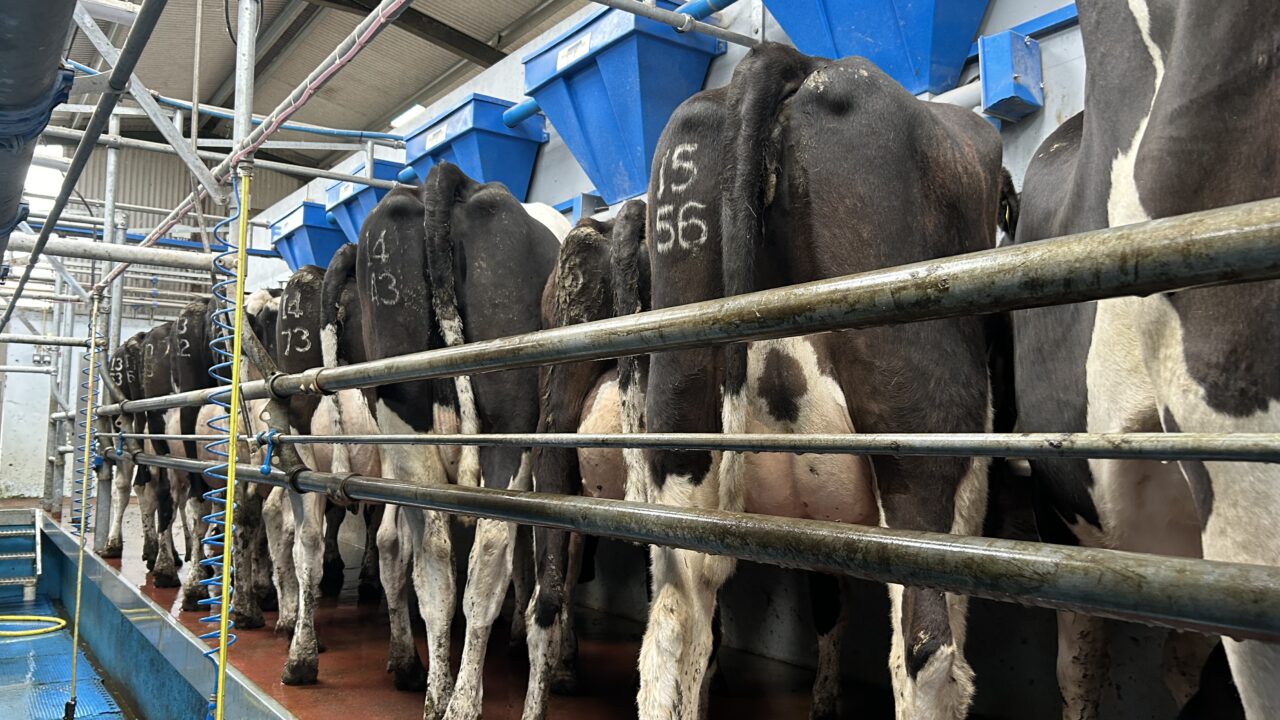
Keeping mastitis out of the herd is crucial at this stage, as a lot of cows will be nearing peak milk production.
Peak milk production typically occurs in or around 50-60 days post calving, which will be now for herds that begin calving down February 1.
Therefore, a mastitis outbreak now would hit milk cheques hard, especially if you begin to lose quarters.
And as spring calving starts to winds down, it can still be easy to let somatic cell counts (SCC) spike.
Even though the first six weeks of calving are the most hectic, the majority of farmers have a great routine in place.
Whether that be freshly calved groups, stripping and California mastitis-testing (CMT), or heightened hygiene, the work is put in to keep mastitis out.
But once farms get to this stage they often relax protocols, and before they know it SCC is on the rise.
Keeping mastitis out
When trying to keep mastitis out, it is important to remember that late calvers will require the same level of attention as every cow that has calved prior to them.
It would be no harm to stay operating a fresh calving group so that they can be monitored carefully and given special treatment if needed, as well as the usual stripping and CMTs.
Upkeeping hygiene in the parlour as well as cubicles for cows still housed also needs to continue to keep the rest of the herd safe from infection.
It may also be worth analysing the milking routine, as it is actually one of the most effective ways of keeping SCC at a minimum.
If it has not yet already been done, you should carry out a milk recording to understand how the dry period went and to pick out any problem cows, marking them for culling or beef straws ahead of the breeding season.
This milk recording will also greatly benefit farmers in making decisions around breeding, as the best performing cows in the herd can be marked for dairy artificial insemination (AI).
For farms that have not yet carried out milk recordings, they will have to closely monitor their bulk tank SCC to understand what their current cell count status is.
Treatment
If mastitis does get into the herd at this time of the year, preventing the infection from spreading through the herd will be crucial.
The infected cow should be separated from the herd immediately, milked after the main herd, and have their cluster thoroughly disinfected after each milking.
If you are pre-spraying your herd, ensure that the contact time is at least 30 seconds, then dry off the spray with a paper towel before attaching the cluster.
Ensure that automatic cluster removers (ACRs) are calibrated to avoid over-milking resulting in teat end damage.
If no ACRs are in place, remove the cluster when a single stream of milk is visible.
Once the cow is milked, farmers should be using the correct post-milking teat disinfectant of roughly 15ml/cow/milking, ensuring full teat coverage.
If there is high SCC in cows for some time and they are showing no signs of improvement, a sample should be taken from the infected quarter(s) and sent to a laboratory to identify the pathogen that is causing the elevated SCC.
A sensitivity test will identify the offending pathogen as well as the correct antibiotic to use as a treatment.