

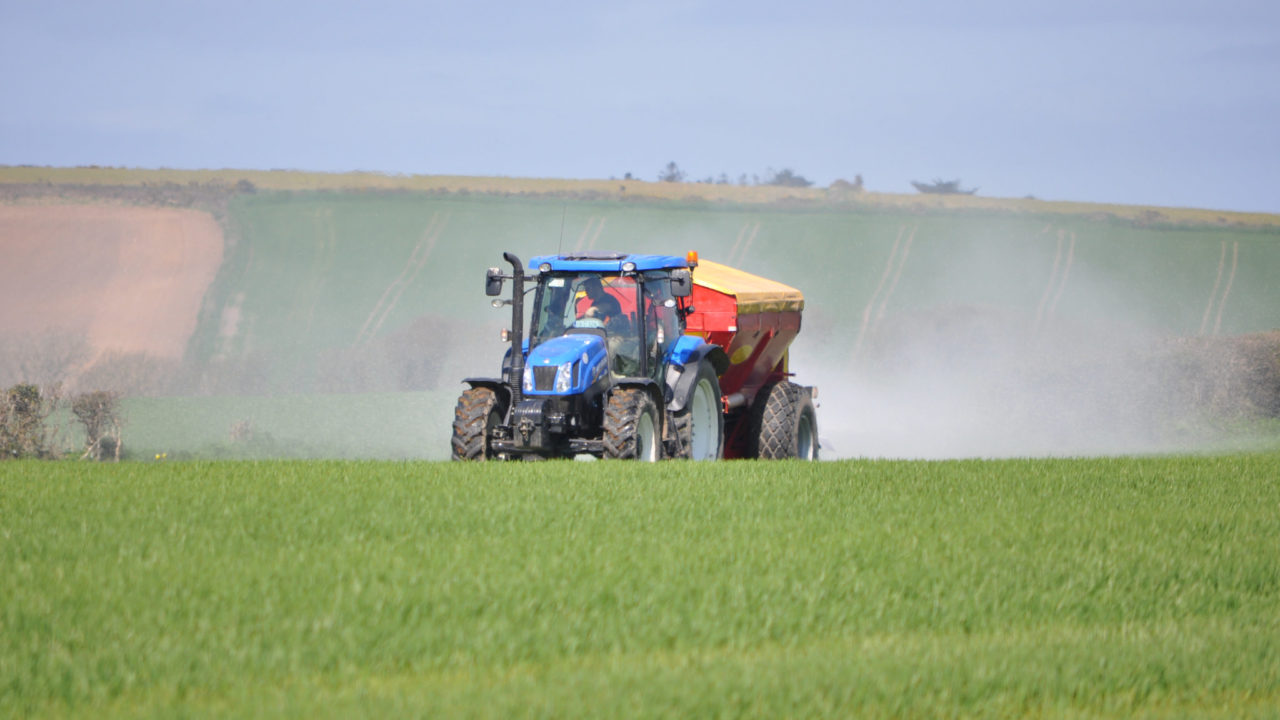
The National Farmers’ Union (NFU) has called on the UK government to postpone the introduction of the Carbon Border Adjustment Mechanism (CBAM) over fears that it might further increase fertiliser prices for farmers.
This call to action was made within the farming union’s fertiliser resilience plan, which was published on Wednesday (June 10).
Following the outbreak of the conflict in the Middle East, NFU stated that the British agriculture sector is still facing rising production costs as “disruption out of the Strait of Hormuz continues to impact farmers and growers”.
According to the NFU, fertiliser prices increased by almost 40% in April, when compared to pre-war levels.
Reports indicate that “the price of fertiliser has exceeded £500/t several times since the conflict began, with urea having reached £635/t and imported ammonium nitrate hitting £535/t in April”.
Fertiliser resilience
NFU outlined that the UK is “particularly vulnerable to global shocks” as the region currently imports around 60% of its nitrogen fertiliser, with the “remainder being processed or produced domestically using wholly imported ammonia.”
Within its fertiliser resilience plan, NFU called upon the government to consider a list of actions, which are aimed at “delivering short-term resilience and affordability, and to safeguard our domestic food production”.
A key recommendation within the plan advises government officials to “launch a mirror of EU compensation schemes” if imported ammonium nitrate hits a “trigger pont” of £500/t.
While advising the postponement of CBAM, NFU also recommended the government to conduct a market review in 12 months as well, with NFU claiming that CBAM’s introduction could “further increase fertiliser costs, create import friction, and risks sparking further food price inflation”.
AHDB
The NFU also called on the Agricultural and Horticultural Development Board (AHDB) to consider some recommendations within the fertiliser resilience plan.
The farming union urged AHDB to “address market failures” by tackling “information gaps in nutrient management” in order to minimise the risk of growers reducing or delaying the application of “essential nutrients, potentially harming crop productivity”.
In addition to this, NFU encouraged AHDB to provide additional insights and transparency on the fertiliser supply chain, which could “address market failure and enable growers to make rational decisions at the point of purchase”.
NFU
Looking ahead to harvest 2027, NFU president Tom Bradshaw noted that the supply of fertiliser “must be affordable” for farmers and growers next year.
Bradshaw said: “It is vital both industry and government take the necessary actions now to help ease this strain.
“In the long-term, it all comes down to resilience; [farmers] can’t keep being collateral damage to global politics.
“We need to find ways to build fairness, transparency and support into our domestic food production system so we can continue to feed 70 million people three times a day,” he added.